 listicle
American Family Auto Insurance Alternatives: 2026 Comparison
Table of Contents
- Best American Family Auto Insurance Alternatives
- How to Compare Auto Insurance Quotes Effectively
- Factors Affecting Car Insurance Premiums
- Coverage Options and Policy Types Across Carriers
- Discounts and Savings Opportunities
- Customer Satisfaction and Claims Experience
- Switching from American Family: What to Know
- Conclusion
Last Updated: August 14, 2026
Best American Family Auto Insurance Alternatives
When you've been with American Family for years, switching feels risky. But that comfort often costs more than it should. At Osime Insurance Agency, Inc, we help clients find American Family alternatives that deliver better rates, more tailored coverage, and service matching what they're paying for. The auto insurance market has fragmented significantly, specialists now outcompete one-size-fits-all carriers.
This guide walks you through the strongest American Family alternatives, how to evaluate them properly, and what changes when you switch.
Quick Comparison Table
| Carrier | Starting Price | Best For | Key Strength |
|---|---|---|---|
| Osime Insurance Agency, Inc | Custom Quote | Personalized service & tailored coverage | Specialists in auto, home, commercial, life |
| GEICO | $46/month | Budget-conscious drivers | 24/7 roadside service, 20+ discounts |
| Progressive | $50/month | Customizable coverage & gap insurance | Snapshot telematics program |
| State Farm | $47/month | Local agent preference & bundling | Drive Safe & Save program, strong discounts |
| USAA | $36/month | Military & veterans only | Lowest rates for eligible members |
| Erie Insurance | $44/month | Excellent customer service (12-state service area) | Unique Rate Lock feature |
How to Compare Auto Insurance Quotes Effectively
Comparing quotes requires controlling for variables. Pull your American Family declarations page and note your liability limits, deductible amounts, and add-ons. When requesting quotes from alternatives, specify these exact coverage levels so price differences reflect actual carrier pricing, not coverage differences.
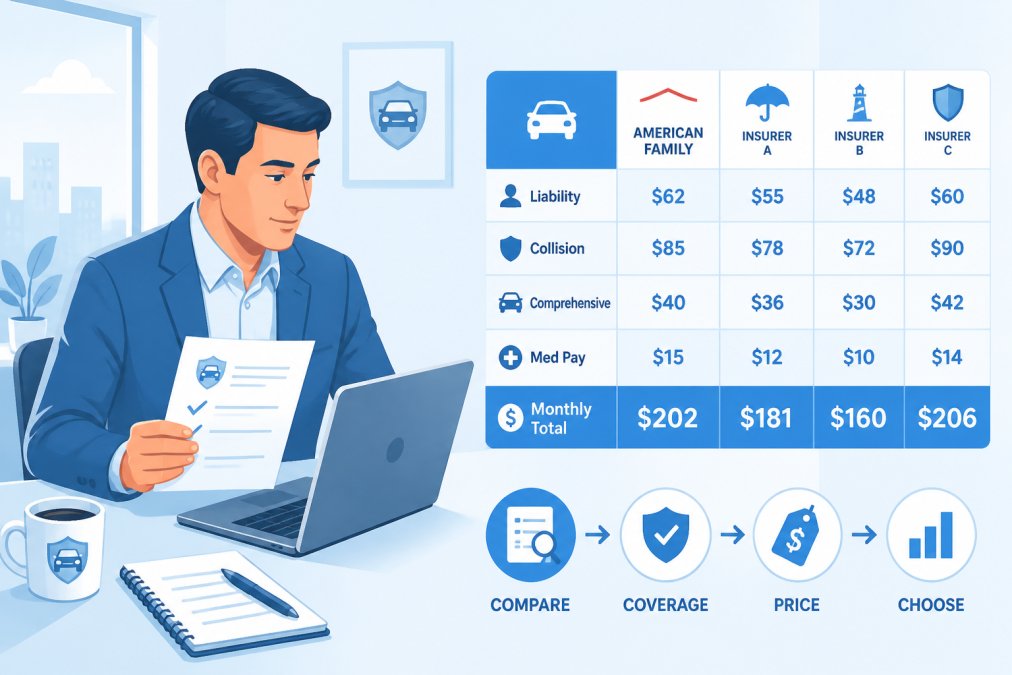
Request quotes for your exact situation: your address, specific vehicles with VINs, and actual driving history. Generic quotes are worthless for comparison. Use aggregator tools for breadth, then follow up with direct quotes from carriers you're seriously considering, many offer discounts unavailable through aggregators.
Document everything in a spreadsheet: carrier, monthly premium, deductible, liability limits, discounts applied, and add-ons. The goal is finding where coverage matches what you're paying.
Factors Affecting Car Insurance Premiums
Your premium reflects predictive models built on decades of claims data. Understanding what moves the needle helps you anticipate quotes and find savings.
Driving record is the first major factor. A clean record gets the best rates; a single at-fault accident increases premiums 20-40%. A DUI results in 50-100% increases. Some carriers are more forgiving than others, Progressive is notably more lenient on violations than GEICO.
Age and experience affect pricing dramatically. Drivers under 25 pay significantly more, sometimes double what a 40-year-old with an identical record pays. Teen drivers are especially expensive.
Vehicle type influences quotes. A 2026 Honda Civic with advanced safety features costs less to insure than a 2020 sports car. Insurers care about repair costs and loss history.
Location and parking matter. Urban areas with higher theft and accident rates generate higher premiums than rural areas. Parking in a garage versus on the street affects your quote.
Annual mileage is increasingly important. Drivers commuting 50 miles daily pay more than those driving 5,000 miles yearly. Usage-based programs like Progressive's Snapshot track actual driving and lower premiums for safe, infrequent drivers.
Credit-based insurance scores predict claim likelihood and can increase premiums 20-30%, though some states restrict this factor's weight.
Coverage Options and Policy Types Across Carriers
Liability coverage is mandatory and covers damage you cause to others. Most states require minimum limits like 25/50/25, but that's dangerously low. Osime Insurance Agency, Inc recommends 100/300/100 or higher based on your assets.
Comprehensive and collision coverage protect your own vehicle. Collision covers accidents; comprehensive covers theft, weather, vandalism, and animals. Your deductible choice (typically $250, $500, or $1,000) directly affects your premium.
Uninsured and underinsured motorist protection covers you if someone without adequate insurance hits you. This is critical and affordable.
Gap insurance covers the difference between what you owe on a financed vehicle and its actual value if totaled. Progressive includes this as an option.
Roadside assistance covers towing, lockouts, fuel delivery, and jump-starts. GEICO includes this as standard.
Accident forgiveness prevents rate increases after your first at-fault accident. It's not free but can save money long-term.
Discounts and Savings Opportunities
Discounts are where real savings happen. The advertised rate is almost never what you actually pay.
Multi-policy bundling is the biggest discount. Combining auto and home insurance typically saves 15-25%. State Farm advertises bundling discounts up to 30%.
Safe driver discounts reward clean records automatically. Going 3-5 years without an accident or violation qualifies for additional discounts.
Usage-based insurance programs tie premiums to actual driving. Progressive's Snapshot can save up to $328 per year for safe drivers. State Farm's Drive Safe & Save offers potential savings up to 30%.
Good student discounts apply to students with a 3.0 GPA or higher.
Low-mileage discounts apply if you drive under 7,500-10,000 miles yearly. Allstate's Milewise charges based on miles driven.
Anti-theft device discounts apply if your vehicle has a GPS tracker or immobilizer.
Employment-based discounts exist through some employers. Ask your HR department about partnerships.
Loyalty discounts reward long-term customers. When you switch, you lose this with your old carrier but gain it slowly with the new one.
Customer Satisfaction and Claims Experience
Premium and coverage are half the story. How a carrier handles claims is the other half.
Customer satisfaction ratings vary significantly. USAA ranks highest but membership is restricted to military and veterans. Erie Insurance ranks exceptionally high in its 12-state service area. State Farm and GEICO rank well nationally.
Claims processing speed matters. Some carriers offer same-day or next-day resolution; others take weeks. Progressive and Allstate have strong mobile apps for digital-first service. State Farm's agent network is unmatched for those preferring local agent relationships.
Financial strength ratings from A.M. Best indicate claim-paying ability. GEICO has an A++ rating. All major carriers listed here are financially stable.
Osime Insurance Agency, Inc helps clients navigate claims logistics, ensuring you understand what happens when you file, how to document damage, and what to expect.
Switching from American Family: What to Know
Switching is simpler than most think, but logistics matter.

Request quotes without notifying American Family. Once you've found something better, provide the new carrier with your policy details. They'll generate a quote and handle the transition.
Timing is critical. Coordinate so the new policy starts the day your American Family policy ends, preventing coverage gaps. Don't cancel first, activate new coverage first, then cancel.
Check for cancellation penalties. American Family's policy varies by state. If there's a penalty, factor it into your savings calculation.
Lapse in coverage is serious. If your American Family policy lapses before new coverage starts, your driving record gets marked with a lapse, increasing premiums with the new carrier. Coordinate effective dates precisely.
Your driving record transfers with you. A new carrier will see your history, but some carriers price violations differently. Compare quotes across multiple carriers if you have recent violations.
If you had home and auto bundled with American Family, decide whether to move both to the same new carrier. Moving both usually saves more money.
Conclusion
American Family alternatives exist across a wide spectrum, each optimized for different driver profiles. GEICO excels for budget-conscious drivers. Progressive builds around customizable coverage and telematics. State Farm dominates for local agent relationships and bundling. USAA offers best rates for military and veterans. Erie delivers exceptional customer service in its service area.
The decision is finding the best match for your situation. Your driving record, age, location, vehicle type, and bundling needs all affect which alternative makes sense.
At Osime Insurance Agency, Inc, we help clients navigate this decision by analyzing their specific situation and comparing options across carriers. Our specialists provide personalized guidance, ensuring you understand the premium, coverage, and claims experience you can expect.
Get your free quote from Osime Insurance Agency, Inc today and see how much you could save.
Frequently Asked Questions
What are the best American Family auto insurance alternatives?
Top alternatives include GEICO, Progressive, State Farm, Allstate, Liberty Mutual, Farmers, USAA (for military members), and Erie Insurance. Each offers different strengths: GEICO and State Farm for competitive rates, Progressive for customizable coverage, and USAA for the lowest premiums if you're eligible. Your best choice depends on your driving profile, location, and coverage needs. Get quotes from multiple carriers to compare.
How do I compare auto insurance quotes from different providers?
Request quotes using identical coverage levels, deductibles, and policy limits across all carriers. Note the base premium, available discounts, and any add-on costs. Check each insurer's financial strength rating (AM Best ratings) and customer satisfaction scores. Review the declarations page to confirm liability coverage limits and collision/comprehensive coverage match. Compare the total annual premium, not just monthly rates, and factor in bundling discounts if you need multiple policies.
What factors affect my car insurance premium the most?
Your driving record, age, and vehicle type are primary factors. Insurers also assess credit-based insurance scores, annual mileage, and your location. Safety features, accident history, and prior insurance lapses influence rates. Some carriers offer usage-based insurance programs (telematics) that monitor driving habits and can lower premiums for safe drivers. Bundling home and auto policies, maintaining good credit, and taking advantage of available discounts can significantly reduce your premium.
Is switching auto insurance worth the hassle and potential rate changes?
Switching can save hundreds annually if you find a carrier with better rates for your profile. Many drivers overpay by not shopping around. The process is straightforward: get quotes, choose a new insurer, provide your current policy details, and request a start date that avoids any coverage gaps. Most carriers handle the transition smoothly. However, avoid lapses in coverage, as these trigger underwriting penalties and higher premiums with future insurers.
How does claims satisfaction differ between American Family and its alternatives?
Claims satisfaction varies by carrier and state. GEICO, State Farm, and Progressive rank highly for claims processing speed and customer service. Erie Insurance and USAA also report strong satisfaction ratings. Review independent ratings from J.D. Power and the National Association of Insurance Commissioners (NAIC) for your state. Ask prospective insurers about their average claims processing time, 24/7 claims reporting options, and whether they offer roadside assistance or accident forgiveness to protect you after an incident.
This article was written using GrandRanker