 ultimate-guide
Commercial Liability Insurance for Construction: 2026 Guide
Table of Contents
- What Is Commercial Liability Insurance for Construction Businesses?
- What Does General Liability Insurance Cover?
- Types of Construction Insurance Policies You Need
- How to Get a Certificate of Insurance for Construction
- Contractor General Liability Insurance Cost Factors
- Choosing the Right Coverage Limits for Your Construction Business
- State-Specific Insurance Mandates for Construction
- Common Construction Insurance Claims and How Coverage Protects You
- Frequently Asked Questions
Last Updated: August 6, 2026
What Is Commercial Liability Insurance for Construction Businesses?
Commercial liability insurance for construction is a policy that protects construction businesses from financial losses due to bodily injuries, property damage, or legal claims arising from their operations. For contractors, this coverage is essential because construction work inherently involves risks, from slip-and-fall accidents on job sites to damage caused by equipment or completed work.
At Osime Insurance Agency, Inc, we work with construction businesses of all sizes to ensure they understand what this coverage actually protects. The policy covers third-party claims, meaning it pays for injuries or damage to someone else's property, not your own. Without this protection, a single accident could bankrupt a small contracting firm.
Construction businesses face unique exposures that general commercial policies may not fully address. A subcontractor might damage a client's existing structure, a worker could injure a homeowner during a renovation, or completed work could fail and cause property damage months later. Commercial liability insurance steps in to handle the legal defense costs and settlement expenses, allowing your business to continue operating instead of being drained by litigation.
The cost of this coverage varies based on your business size, claims history, coverage limits you choose, and the specific type of construction work you perform. Most contractors need multiple insurance policies working together, general liability is just one piece of a comprehensive risk management strategy.
What Does General Liability Insurance Cover?
General liability insurance provides broad protection against common construction-related claims. Understanding what's included helps you identify gaps in your coverage and ensure you're protected for the specific work your business does.
Bodily Injury and Property Damage Claims
Bodily injury coverage pays for medical expenses, lost wages, and pain-and-suffering claims when someone is injured due to your construction work. Property damage coverage pays when your operations damage someone else's property. These are the two most common claims in construction.
A subcontractor accidentally breaks a homeowner's kitchen cabinet while installing countertops. The property damage portion of your general liability policy covers the replacement cost. A worker's nail gun misfires and injures a client's employee on the job site. The bodily injury portion covers medical bills and any resulting lawsuit.
Most construction businesses carry coverage limits between $1 million and $2 million per occurrence, though larger projects or specialized work may require higher limits. Your clients, especially property owners and general contractors, will typically require you to carry minimum limits as a condition of the contract.
Personal and Advertising Injury
This coverage protects against claims of defamation, invasion of privacy, copyright infringement, or false advertising. While less common than bodily injury or property damage claims, these situations do arise in construction.
If you're accused of damaging someone's reputation through false statements about a competitor, or if your marketing materials inadvertently use someone's image without permission, this portion of your policy covers the legal defense and any settlement. For most small to mid-sized contractors, this is a secondary concern, but it's valuable to have in place.
Legal Defense Costs
Construction disputes often lead to lawsuits, and legal defense costs can exceed the actual settlement amount. Your general liability policy covers attorney fees, court costs, and expert witness expenses, regardless of whether you win or lose the case.
This is critical because some policies include defense costs within the coverage limit (reducing the amount available for settlement), while others pay defense costs in addition to the limit. When shopping for coverage, clarify this distinction with your insurance agent. Many contractors find that defense-outside-the-limit policies provide better protection, though they may cost slightly more.
Types of Construction Insurance Policies You Need
Construction businesses typically need multiple insurance products working together. General liability is foundational, but it doesn't cover everything.
General Liability vs. Professional Liability
General liability covers bodily injury and property damage from your construction operations. Professional liability (also called errors and omissions insurance) covers claims that your work was defective, negligent, or failed to meet specifications.
The distinction matters. If your crew accidentally damages a client's property during installation, general liability covers it. If the roof you installed leaks because of improper installation, professional liability covers the cost to fix it and any resulting property damage inside the building. Architects, engineers, and specialized contractors (like HVAC or electrical) often carry professional liability. General contractors and trade workers primarily need general liability, though some larger firms carry both.
Workers' Compensation and Contractual Liability
Workers' compensation is mandatory in most states and covers medical expenses and lost wages for employees injured on the job. This is separate from general liability and is required by law if you have employees.
Contractual liability covers claims that arise from contracts you've signed. Many clients require you to name them as an "additional insured" on your policy, meaning they're protected under your coverage. Your policy should explicitly cover contractual liability to ensure these requirements are met without gaps.
How to Get a Certificate of Insurance for Construction
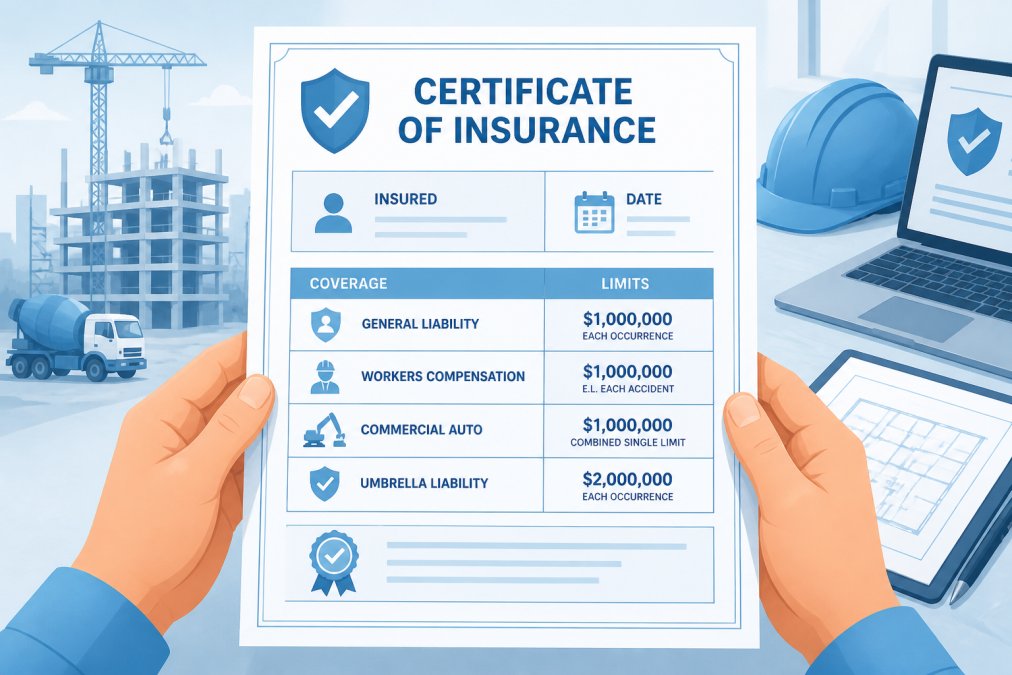
A certificate of insurance is a document issued by your insurance agent that proves you carry the required coverage. Clients and general contractors demand these before allowing you on their job sites.
Step-by-Step Certificate Process
Step 1: Contact your insurance agent. Request a certificate of insurance naming the specific client or project as the certificate holder. This takes 5-10 minutes and can often be done via email or phone.
Step 2: Specify required information. Provide the project name, client name, job site address, and any special requirements (such as naming them as additional insured). Some contracts specify exact coverage limits or policy types required.
Step 3: Receive the certificate. Your agent will issue a standard ACORD certificate (the industry-standard form) within hours. This document includes your policy numbers, coverage limits, and effective dates.
Step 4: Deliver to the client. Email or print the certificate and submit it to the client before work begins. Keep copies for your records.
Step 5: Update as needed. If your policy renews or changes, request updated certificates. Don't let outdated certificates delay project start dates.
Why Clients and Contractors Require It
General contractors and property owners require certificates because they're protecting themselves. If you're injured on their job site or your work damages their property, they want proof that your insurance will cover the claim, not their own policy. This protects their insurance rates and liability exposure.
Subcontractors often require certificates from their sub-tier contractors for the same reason. It's a standard risk management practice in the industry and a non-negotiable requirement for most projects.
Contractor General Liability Insurance Cost Factors
Your premium depends on multiple variables that underwriters assess to determine your risk profile.
How Underwriters Calculate Your Premium
Underwriters evaluate your business size (annual revenue), the types of construction work you perform, your claims history, and your safety practices. A roofing contractor carries more risk than a painting contractor, so roofing premiums are typically higher.
Your payroll also affects the premium. Workers' compensation insurance is calculated per $100 of payroll, so larger crews mean higher costs. Some policies also consider the number of vehicles you operate and whether you rent equipment.
Your loss history matters significantly. If you've filed multiple claims in the past five years, your premium will reflect that risk. Conversely, a clean claims history can qualify you for discounts.
Coverage Limits and Deductibles Impact on Price
Higher coverage limits increase your premium proportionally. A $1 million policy costs less than a $2 million policy, but the difference is smaller than many contractors expect, often 15-25% more.
A higher deductible (the amount you pay out-of-pocket for each claim) lowers your premium. Some contractors choose $5,000 or $10,000 deductibles to reduce costs, but this only makes sense if you can actually afford to pay that amount if a claim occurs. For most small contractors, a $1,000 deductible strikes the right balance.
Choosing the Right Coverage Limits for Your Construction Business
Your coverage limits should reflect the value of projects you undertake and the potential exposure if something goes wrong.
Most residential contractors carry $1 million per occurrence and $2 million aggregate. This covers typical home renovation and construction projects. Commercial contractors, especially those working on larger projects, often carry $2 million per occurrence and $4 million aggregate.
Consider the contracts you sign. Many clients specify minimum coverage limits as a condition of hiring you. If you regularly bid on projects requiring $2 million coverage, carrying only $1 million means you can't compete for those jobs. Osime Insurance Agency, Inc helps contractors right-size their coverage based on their typical project values and client requirements.
A practical approach: review your contracts from the past year and note the coverage limits clients required. Choose limits that cover 90% of your projects without paying for excessive coverage you'll never use.
State-Specific Insurance Mandates for Construction
Insurance requirements vary by state. Some states mandate specific coverage types, while others leave it to market competition and client requirements.
Most states require workers' compensation insurance if you have employees, with specific coverage minimums. Some states require licensed contractors to carry general liability insurance as a condition of licensure. A few states have specific requirements for construction contractors related to completed operations coverage, which protects you if work you completed causes damage months or years later.
Contact your state's licensing board or construction regulatory agency to confirm what's required in your jurisdiction. Your state may also have specific rules about certificate of insurance forms, additional insured endorsements, or waiver-of-subrogation clauses that clients can require.
Common Construction Insurance Claims and How Coverage Protects You
Understanding real-world claims helps you appreciate why each part of your policy matters.
Slip-and-fall claims are among the most common. A homeowner slips on wet flooring during a kitchen renovation and breaks their arm. Your bodily injury coverage pays for their medical expenses and any settlement. Without this coverage, you'd be personally liable for thousands in medical bills and pain-and-suffering damages.
Property damage claims arise when your work damages existing structures. A roofer's ladder slides and punctures a gutter. A framing crew accidentally cuts through electrical wiring. Your property damage coverage handles the repair costs and any resulting liability.
Completed operations claims occur after work is finished. A roof installed six months ago begins leaking due to improper installation. The homeowner sues for water damage inside the home. Your completed operations coverage (often included in general liability policies) covers this claim even though the injury occurred long after you left the job site.
Contractual liability claims arise when contracts require you to assume liability for things outside your control. A client requires you to assume liability for damage caused by their own negligence. Your contractual liability coverage ensures your policy responds to these unusual requirements.
Protecting your construction business means understanding what coverage you need and ensuring you carry adequate limits. At Osime Insurance Agency, Inc, we specialize in commercial insurance for construction businesses and help contractors navigate coverage options, state requirements, and certificate processes. Our experienced team takes time to explain your coverage in plain English so you feel confident about your protection. Get your free quote today and discover how affordable tailored construction insurance can be.
Frequently Asked Questions
What kind of insurance do I need for a construction business?
Most construction businesses need general liability insurance as a foundation, which covers bodily injury and property damage claims. You'll also typically need workers' compensation (required in most states), commercial property insurance for tools and equipment, and professional liability if you provide design services. Many clients and contracts require a certificate of insurance before you start work. Subcontractors should carry their own liability coverage, and you may need contractual liability to protect against indemnity agreements in your contracts.
How much does contractor general liability insurance cost?
Contractor general liability insurance cost depends on your business size, type of work, claims history, coverage limits, and deductible amount. Factors like location, experience level, and the specific construction services you offer affect your premium. For an accurate quote tailored to your business, contact Osime Insurance Agency to discuss your specific situation. We'll evaluate your risk profile and help you find affordable coverage that meets your needs.
What is the difference between general liability and professional liability for construction?
General liability covers third-party bodily injury and property damage claims, like a customer slipping on your job site or your work damaging a client's existing structure. Professional liability (errors and omissions) covers claims arising from mistakes in your professional services, design errors, or failure to deliver as promised. Architects, engineers, and design-build contractors often need professional liability. General contractors typically focus on general liability, while some need both depending on their service scope.
Does commercial liability insurance cover damage to property I am working on?
Standard general liability insurance typically excludes damage to property you're actively working on, that's covered under completed operations coverage (part of many GL policies) once the work is finished. Damage to a client's property caused by your work may be covered, but damage to the structure itself during construction usually requires a builder's risk or course of construction policy. Review your policy exclusions carefully, and ask your agent whether your current coverage includes completed operations protection.
What is the difference between a $1 million and $2 million liability policy?
The difference is your coverage limit, the maximum amount the insurance company will pay for claims. A $1 million policy covers up to $1 million per claim; a $2 million policy covers up to $2 million. Higher limits cost more but offer greater protection if a serious injury or property damage claim occurs. Your choice depends on your contract requirements, project scope, and risk tolerance. Osime Insurance Agency can review your typical project values and help you select appropriate limits for your business.
How long does the insurance claims process take?
The claims process timeline varies based on claim complexity. Simple claims may resolve in weeks; complex ones involving investigation, multiple parties, or litigation can take months. When you file a claim, the insurer assigns an adjuster who investigates, collects documentation, and determines coverage. You'll receive updates throughout, but timelines depend on the specific circumstances. Osime Insurance Agency is committed to supporting you through the entire process and ensuring you understand what to expect at each stage.
What is a certificate of insurance and why do I need it?
A certificate of insurance is a one-page document proving you carry active liability coverage. It shows your policy number, coverage limits, and the insurer's contact information. Clients, general contractors, property owners, and lenders often require it before you start work, it's proof you're financially protected and can cover damages if something goes wrong. Getting a certificate is simple: ask your insurance agent to issue one, and you can usually receive it within hours. Many insurers allow online certificate requests.
Are there state-specific insurance requirements for construction businesses?
Yes. Most states require workers' compensation insurance if you have employees. Some states mandate specific coverage limits or additional insured endorsements on general liability policies. Licensing boards and contractor regulations vary by state, some require proof of insurance to obtain or renew licenses. Local jurisdictions may also have job site safety requirements affecting your coverage needs. Contact Osime Insurance Agency to confirm your state and local requirements; we stay current on regulations that affect your business.
This article was written using GrandRanker