 How-to
Does a New Deck Increase Homeowners Insurance?
Last Updated: October 25, 2026
Quick Summary
Whether does a new deck increase homeowners insurance depends on your current coverage limits and your insurer's risk assessment. If your dwelling coverage already exceeds your home's replacement cost, a deck might not trigger any increase. But if your coverage was tight, the deck could require an adjustment to keep pace with your home's new value.
- You must notify your insurer about a new deck within 30 to 60 days to avoid claim denial or coverage gaps.
- Attached decks are covered under dwelling coverage, while detached decks may have lower limits or different terms depending on your policy.
- Personal liability coverage typically starts at $100,000 and protects you if someone is injured on your deck.
- A deck's replacement cost depends on size, materials, labor costs in your region, and local building code requirements.
- Safety upgrades to your deck may help lower premiums, but the deck itself rarely triggers a discount.
Table of Contents
- How a New Deck Affects Your Homeowners Insurance Premium
- Understanding Homeowners Insurance Coverage for Decks
- Do I Need to Tell My Insurance Company About a Deck?
- Calculating Deck Replacement Cost for Insurance Purposes
- Liability Risks and Coverage Limits for Deck Structures
- When Renovations May Lower Your Insurance Costs
- Getting Your Deck Coverage Right
- Frequently Asked Questions
How a New Deck Affects Your Homeowners Insurance Premium
Whether does a new deck increase homeowners insurance depends on several factors. At Osime Insurance Agency, Inc, we help homeowners understand how home improvements impact coverage and costs.
When you add a deck, your home's replacement cost, what your insurer would need to spend to rebuild your house from scratch, increases. Your insurer may adjust your dwelling coverage (the part that protects the structure itself) upward to reflect this change.
Here's what most homeowners miss: understanding does a new deck increase homeowners insurance requires knowing your current coverage limits, since your premium might stay the same, go down, or go up. Learn how various home improvements impact insurance premiums to get broader context for deck-specific impacts.
The timing matters too. You need to notify your insurer about the deck before you file a claim. Failing to do so could leave you underinsured or facing a claim denial.
Understanding Homeowners Insurance Coverage for Decks
Your homeowners insurance policy covers your home's structure, including attached decks. Dwelling coverage pays to repair or rebuild your house and its permanent structures if they're damaged by covered perils like fire, wind, or theft.
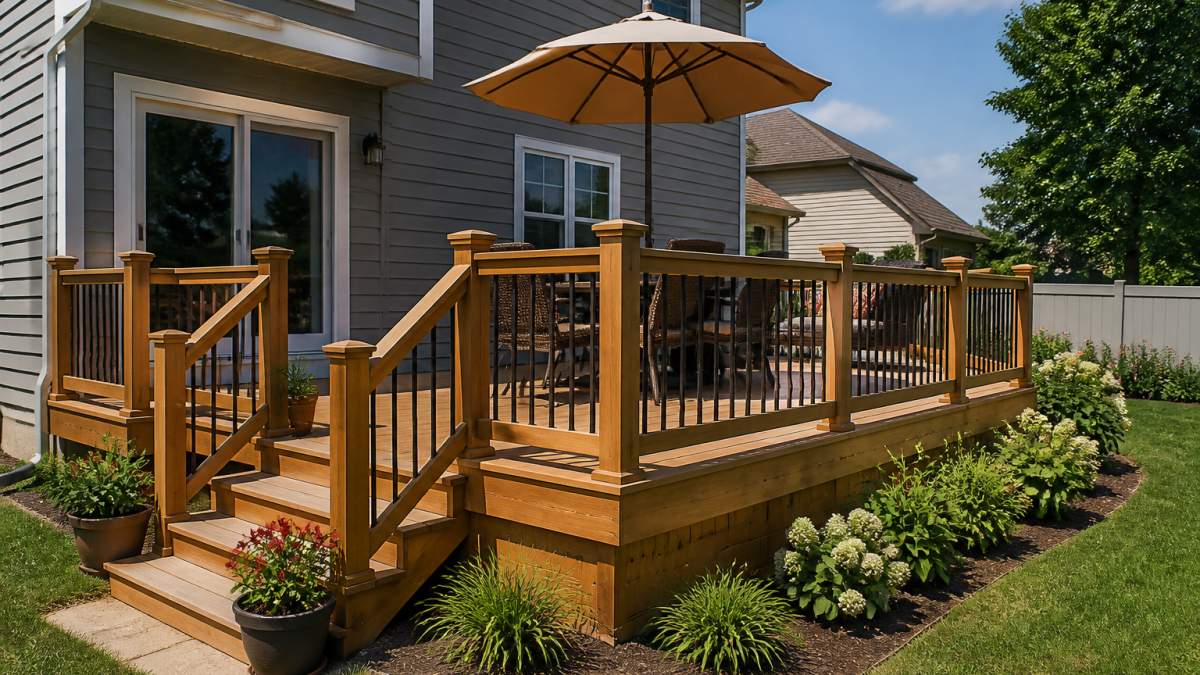
Decks permanently attached to your home are covered under your dwelling coverage limit. But limits vary widely, some policies cap coverage at a percentage of your home's value, others set a fixed dollar amount. Understand your specific limits before you build.
Personal property coverage is different, it protects belongings inside the home. Deck furniture, grills, and outdoor equipment may or may not be covered depending on your policy. Check your declarations page for your actual dwelling coverage limit.
Attached vs. Detached Decks
An attached deck is physically connected to your home, sharing a wall or foundation. Attached decks are treated as part of your home's structure and covered under dwelling coverage. Most decks fall into this category.
A detached deck stands alone in your yard. Detached decks are typically covered, but sometimes with lower limits or different terms. Some policies treat detached structures separately; a few exclude them entirely. Ask your agent directly before you build one.
The distinction matters for claims: an attached deck claim goes straight to dwelling coverage, while a detached deck claim may require separate evaluation or carry different deductibles.
Deck Location and Construction Materials
Where your deck sits affects how your insurer views it. A first-floor deck is lower risk than a second-story deck, which presents higher liability exposure if someone falls. Some insurers charge more for them or require safety features like higher railings or fall-arrest systems.
Materials matter too. Pressure-treated wood is standard and usually poses no additional cost. Composite decking or exotic hardwoods don't typically change your premium, but they may affect the replacement cost calculation, what it would cost to rebuild the deck to the same standard.
Railings, stairs, and structural integrity factor into whether your deck meets building codes. A deck that doesn't meet local code may face coverage restrictions or higher premiums, and your insurer may require proof it was built to code before covering it fully.
Do I Need to Tell My Insurance Company About a Deck?
Yes. You must notify your insurer about a new deck before you file a claim involving it. Failing to report it could result in a claim denial or coverage gap.
Most policies require you to report any changes to your home's structure or value. A new deck is a structural change, and your insurer needs to know so they can adjust your dwelling coverage limit if necessary and keep your replacement cost estimate accurate.
Timing is flexible for premium purposes, you don't need to call the day after the deck is finished, but report it within a reasonable timeframe, typically 30 to 60 days. Waiting months or years creates a documentation problem if you ever file a claim.
Here's what to do:
- Contact your insurance agent or insurer directly
- Have your deck's dimensions and construction details ready
- Ask whether your dwelling coverage limit needs adjustment
- Request a revised declarations page showing any changes
- Keep documentation of the deck's completion (photos, contractor invoice, building permit if you have one)
Some insurers offer online portals for reporting home changes; others prefer a phone call. Either way, get written confirmation that your report was received, it protects you if a claim dispute arises later.
Calculating Deck Replacement Cost for Insurance Purposes
Your insurer needs to know what your deck would cost to replace if destroyed. This replacement cost feeds into your dwelling coverage calculation.
Replacement cost depends on several factors:
- Deck size (square footage)
- Materials (pressure-treated wood, composite, hardwood)
- Labor costs in your region
- Complexity (simple platform vs. multi-level with built-ins)
- Local building codes and permit requirements
A basic wood deck's cost depends on its size, materials, and regional labor. A composite deck of the same size runs higher. A second-story deck costs more because it requires additional structural support and safety features.
Your insurer doesn't necessarily calculate this themselves. You can provide a contractor's estimate to establish the deck's replacement value. Some insurers send an adjuster to inspect the deck; others use regional cost databases.
Here's the practical part: if your deck's replacement cost is significantly higher than your insurer estimated, your dwelling coverage limit may be too low.
Ask your agent to confirm that your dwelling coverage limit accounts for the deck's replacement cost. If it doesn't, request an increase.
Liability Risks and Coverage Limits for Deck Structures
A deck creates liability exposure. If someone is injured on your deck, they may sue you. Your homeowners insurance includes personal liability coverage to protect you in this situation.
Personal liability coverage typically starts at $100,000 and can go much higher.
Decks present specific liability risks:
- Fall injuries from railings that don't meet code
- Slip-and-fall accidents on wet or icy surfaces
- Structural collapse if the deck was built poorly
- Injuries from unsecured deck furniture or grills
Your liability coverage applies to all of these, but your limit matters. If someone is seriously injured and medical bills plus damages exceed your limit, you could be personally liable for the difference.
Many homeowners are underinsured on liability. A $100,000 limit sounds like a lot until a serious injury occurs. Consider raising your liability limit, especially if you host gatherings on your deck.
Maintenance is also a liability factor. If your deck is in poor condition and someone is injured, your insurer may argue your negligence contributed. Fix loose railings, replace rotted boards, and maintain stairs, this protects both your safety and your claim.
When Renovations May Lower Your Insurance Costs
Some home improvements actually reduce your insurance premium. Understanding which ones qualify helps you make smarter renovation choices.
Safety upgrades often lower premiums. A new roof, updated electrical wiring, or a security system signals to your insurer that your home is lower risk, and your insurer may offer a discount.
A deck itself rarely triggers a discount, but if your project includes safety upgrades, better drainage to prevent water damage, or fire-resistant deck material, your insurer may view your home more favorably. Ask about common home insurance discounts that may apply to deck improvements or safety upgrades.
Some insurers offer discounts for bundling policies. If you add a deck and it prompts you to review your coverage, you might discover that bundling your home and auto policies saves more than any single improvement could cost.
The best way to find savings is to ask your agent directly. Different insurers weight risk factors differently. One insurer might charge more for a deck, while another barely adjusts your premium.
Getting Your Deck Coverage Right
The key to protecting yourself is making sure your coverage keeps pace with your home's value.
Ask these questions: You can also compare home insurance quotes effectively to find the best deck coverage and rates.
- Does my dwelling coverage limit account for the deck's replacement cost?
- Should I increase my coverage limit?
- Is my personal liability limit adequate?
- Are there any exclusions or limitations on deck coverage?
- What happens if the deck is damaged by a specific peril (fire, wind, theft)?
Your agent can walk you through your policy and explain what's covered and what isn't. If you're unsure about your current coverage, book an initial consultation to discuss your specific situation.
Before you file a claim involving your deck, make sure you've reported it to your insurer. Documentation matters.
A new deck adds value and enjoyment to your home, but also complexity to your homeowners insurance.
| Deck Type | Coverage Status | Key Consideration |
|---|---|---|
| Attached deck, first floor | Covered under dwelling | Standard replacement cost calculation |
| Attached deck, second story | Covered under dwelling | Higher liability exposure, may affect premium |
| Detached deck | Usually covered | Verify limits and exclusions with agent |
| Deck with safety upgrades | Covered, potential discount | Report improvements to insurer |
| Step | Action | Timing |
|---|---|---|
| 1 | Complete deck construction | Before filing any claim |
| 2 | Notify your insurance agent | Within 30-60 days |
| 3 | Provide deck details and photos | When reporting |
| 4 | Request coverage review | At notification |
| 5 | Confirm updated declarations page | Before claim occurs |
Common questions about deck coverage and insurance:
Does adding a deck always increase my premium? Not necessarily.
Are detached decks covered the same way as attached decks? Detached decks are usually covered, but the terms may differ.
How much does dwelling coverage increase for a deck? This varies by insurer and region.
EXTERNAL SOURCES:
According to the National Association of Insurance Commissioners, homeowners should review their coverage whenever they make significant home improvements to ensure adequate protection.
The Insurance Information Institute's guide to homeowners insurance explains how home improvements affect coverage and replacement cost calculations.
Research from the Consumer Federation of America shows that many homeowners are underinsured on both dwelling coverage and personal liability, leaving them exposed to significant financial risk.
Frequently Asked Questions
Does adding a deck increase homeowners insurance?
Yes, a new deck typically increases your homeowners insurance premium because it raises your home's replacement cost and expands the insured structure. The increase depends on the deck's size, materials, and whether it's attached or detached. An attached deck is usually considered part of your dwelling coverage, so insurers factor its replacement cost into your policy. Contact your agent for a specific premium adjustment after deck completion.
Do I need to tell my insurance company about a new deck?
Yes, you must notify your insurer about a new deck. Most homeowners insurance policies require you to report significant home improvements within 30 to 60 days. Failing to report a deck may result in a coverage gap, if the deck is damaged and your insurer discovers you didn't disclose it, they could deny the claim. Report the deck's completion date, square footage, materials, and whether it's attached or detached.
How do I estimate deck replacement cost for insurance?
Deck replacement cost depends on materials and regional labor costs. Multiply your deck's square footage by the per-square-foot cost in your area. For composite or premium materials, costs may be higher. Your contractor's invoice is the most reliable figure to provide your insurer. Get a written estimate or invoice to support your claim if damage occurs.
What liability risks should I know about with a deck?
Decks create personal liability exposure, if a guest is injured on your deck due to poor maintenance, unsafe railings, or structural failure, your homeowners insurance liability coverage may cover medical expenses and legal costs. However, your policy typically has liability limits (often $100,000 to $300,000). Deck-specific hazards include falls, railing failures, and weather damage. Regular maintenance and safe design reduce risk and support your claim if an injury occurs.