 ultimate-guide
Is Affordable Home Insurance Actually Reliable?
Table of Contents
- The 'Cheap' Trap: Why Price Alone Doesn't Equal Reliability
- How to Compare Homeowners Insurance Quotes Without Missing Hidden Costs
- Understanding Coverage Limits, Deductibles, and What Actually Gets Paid
- Home Insurance Claim Denial Rates: What You Need to Know
- How to Check Insurance Company Financial Strength Ratings
- Claims-Handling Transparency: The Real Test of Reliability
- Building Your Affordable Yet Reliable Coverage Strategy
Last Updated: August 10, 2026
The 'Cheap' Trap: Why Price Alone Doesn't Equal Reliability
The cheapest homeowners insurance premium doesn't guarantee reliable protection when you need it. At Osime Insurance Agency, Inc, we've watched homeowners lock in bargain rates only to discover coverage gaps or face unexpected claim denials later.
The real question isn't whether affordable homeowners insurance exists, it does. The question is whether you're buying genuine affordability or transferring your risk to a company that won't deliver when it matters. Is affordable home insurance actually reliable? The answer depends on what you're willing to overlook for a lower number.
Some carriers build low premiums by cutting corners on claims handling, underwriting aggressively to deny borderline claims, or maintaining minimal customer service. Others offer competitive pricing because they've optimized operations, not rejection rates.
The gap between cheap and reliable shows up in three places: transparency about what's covered, how quickly and fairly claims are handled, and whether the company has financial strength to pay out during disasters. Skip any of these, and you're buying false security.
How to Compare Homeowners Insurance Quotes Without Missing Hidden Costs
Comparing quotes feels straightforward until you realize identical coverage limits can hide wildly different protections. The $800 annual premium from one carrier might exclude features the $600 quote includes.
Start by getting quotes with identical coverage parameters: same dwelling limit, deductible, and personal property protection across all quotes. This standardization is where most comparisons fail.
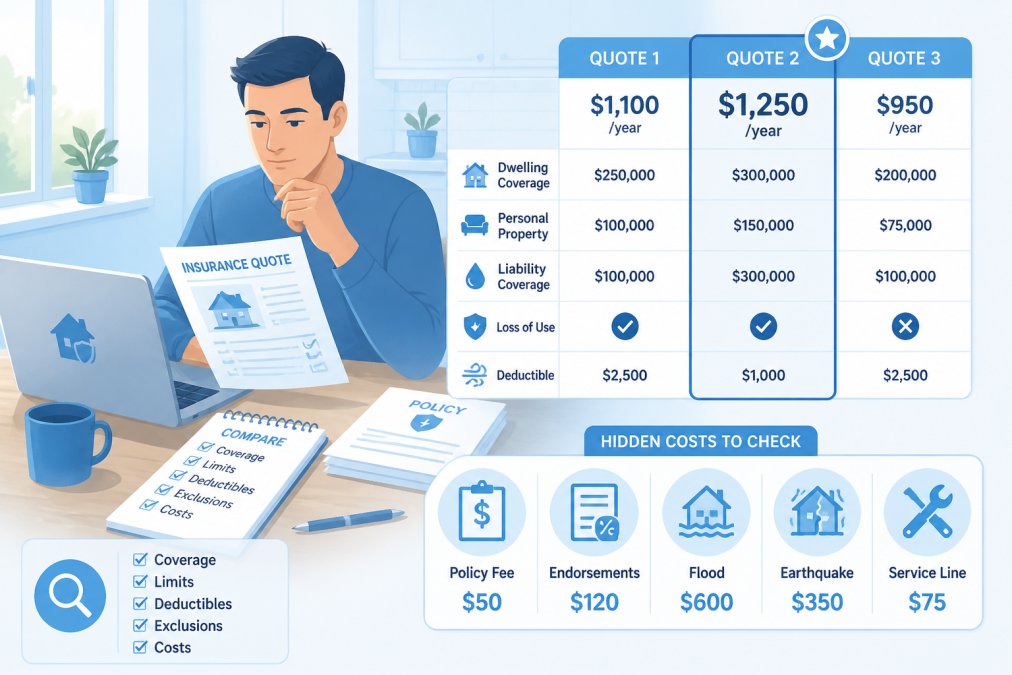
Next, examine what each quote actually covers. One carrier might include replacement cost coverage for belongings; another offers actual cash value only. Replacement cost pays what it costs to replace items today. Actual cash value pays depreciated value, a five-year-old couch might be worth half its replacement cost.
Check the deductible structure. Some carriers offer lower deductibles for specific perils like wind or hail. If you live in an area prone to one type of damage, this significantly affects your actual out-of-pocket exposure.
Request a detailed policy summary, not just a quote sheet. It should spell out exclusions, what the policy explicitly does NOT cover. Common exclusions include flood, earthquake, and maintenance-related failures. If you live near water or in a seismic zone, this matters enormously.
Ask each company directly: "What are your top three reasons claims get denied?" Their answer reveals how they interpret coverage. A company that says "misrepresentation on the application" is being honest about underwriting standards.
Understanding Coverage Limits, Deductibles, and What Actually Gets Paid
Coverage limits define the maximum an insurance company will pay for each damage type. Your dwelling coverage limit should equal the replacement cost of rebuilding your home from the foundation up, not its market value.
Most policies break coverage into categories: dwelling (the structure), personal property (belongings), liability protection (if someone is injured on your property), and additional living expenses (hotel, food, if displaced). Each has its own limit. A $300,000 dwelling limit doesn't mean belongings are also covered up to $300,000; typically personal property coverage is 50-70% of the dwelling limit.
The deductible is what you pay before insurance kicks in. A $1,000 deductible means you cover the first $1,000 of any claim; the insurance company covers the rest up to the policy limit. Higher deductibles lower premiums but increase your out-of-pocket risk.
Some carriers offer low premiums by setting high deductibles most customers can't afford. When a claim happens, the homeowner discovers they can't pay their $5,000 deductible and ends up uninsured anyway. That's not affordable, that's a trap.
Actual cash value versus replacement cost is where claims disputes happen most. If your roof needs replacement, actual cash value pays based on remaining lifespan when it failed. Replacement cost pays what a new roof costs today. Over a major claim, the difference can be $10,000 or more.
Reliable companies explain this distinction upfront in plain language. Cheaper carriers bury it in fine print, betting you won't notice until you file a claim.
Home Insurance Claim Denial Rates: What You Need to Know
Not all insurance companies deny claims at the same rate. Some carriers have denial rates under 5%; others consistently deny 15-20% of claims. That gap reflects how aggressively a company interprets policy language and investigates claims.
Claims are typically denied for three reasons: the damage isn't covered (it's an exclusion), the homeowner misrepresented something on the application, or the company determines damage was pre-existing or caused by maintenance failure rather than a covered peril.
The first two reasons are legitimate. The third is where reliability gets tested. Did the roof fail because of a covered storm, or because of neglected maintenance? Different companies interpret this boundary differently.
Reliable carriers use transparent claim processes. They assign a specific adjuster, provide regular updates, and explain their reasoning if they deny coverage. They also allow appeals. Unreliable carriers deny claims quickly with minimal explanation and make appeals difficult.
Check a company's actual claim denial rate through complaint data. The National Association of Insurance Commissioners (NAIC) publishes complaint data by carrier. A high complaint-to-claims ratio suggests the company denies or disputes claims more often than competitors.
Ask potential carriers: "What's your average time to claim resolution?" Reliable companies resolve claims in 30-60 days. Companies that drag out the process hope you'll accept a lowball offer out of frustration.
How to Check Insurance Company Financial Strength Ratings
An insurance company's premium doesn't matter if they can't pay claims when disaster strikes. Financial strength ratings tell you whether a carrier has reserves to handle catastrophic losses.
The major rating agencies are A.M. Best, Moody's, Standard & Poor's, and Fitch. A.M. Best is most widely used for insurance. Their ratings range from A++ (superior) down to D (poor). For homeowners insurance, you want A.M. Best rating of A- or higher.
You can check ratings free on A.M. Best's website. Search for the carrier by name to see their current rating, financial stability score, and trend (improving, stable, or declining). A declining trend is a red flag even if the current rating is acceptable.
Why does this matter for affordability? A company with weak financial strength might offer rock-bottom premiums because they're cutting corners to stay solvent. When claims spike after a major hurricane or wildfire, they might deny claims aggressively to preserve cash. In worst cases, they become insolvent and policyholders lose coverage mid-claim.
State insurance regulators maintain guaranty funds that protect policyholders if a carrier fails, but protection is capped (usually around $300,000 per claim depending on your state). If your home is worth more, you're exposed to loss if your insurer fails.
Reliable affordable insurance comes from carriers with A or A+ ratings. They've proven they can handle volatility while maintaining competitive pricing.
Claims-Handling Transparency: The Real Test of Reliability
When you file a claim, transparency becomes everything. A reliable company makes the process clear. An unreliable one leaves you guessing.
Ask how claims are filed. Can you file online, by phone, or through an app? Can you upload photos and documents directly? Reliable companies offer multiple channels and digital options. Companies that insist you mail paperwork or speak to someone during business hours only are making the process harder than necessary.

Ask what happens after you file. Will you get assigned a specific adjuster? How often will they contact you with updates? Reliable carriers assign a single point of contact and commit to regular communication. You should hear from them within 48 hours of filing and receive updates at least weekly until resolution.
Request their claims handling standards in writing. Ask: "What's your target timeline for inspection?" (should be within 5-10 days), "How do you handle disputes about repair estimates?" (they should offer independent appraisal), and "What's your appeal process if I disagree with your determination?" A company that readily provides this information is confident in their process.
Check whether they offer same-day or next-day inspections for urgent claims. If your roof is compromised after a storm and rain is forecast, waiting two weeks for an adjuster creates additional damage. Reliable companies prioritize urgent claims.
Osime Insurance Agency, Inc emphasizes transparent communication throughout the claims process. Our specialists work directly with clients to explain coverage, answer questions, and ensure the claims experience is straightforward, not a source of additional stress.
Ask about their repair process. Some carriers have preferred contractors; others let you choose. Some pay contractors directly; others reimburse you. The most transparent approach is letting you choose your contractor and paying them directly so you're not out-of-pocket while waiting for reimbursement.
Building Your Affordable Yet Reliable Coverage Strategy
Affordable and reliable insurance isn't a contradiction. It requires making intentional trade-offs rather than just picking the lowest number.
Start with your actual risk profile. If you live in an area with low flood risk, you don't need flood insurance, that's legitimate savings. If your home is newer with recent updates, you can accept a higher deductible because your claim risk is lower. If you have significant savings, a $2,500 deductible is affordable and saves money on premiums. If you live paycheck to paycheck, a $500 deductible is the right choice even if the premium is higher.
Bundle coverage if possible. Homeowners insurance bundled with auto insurance typically saves 10-15% on each policy. That's real affordability without sacrificing reliability.
Request a policy review annually. Insurance needs change. If you've renovated your kitchen or added a deck, your dwelling coverage might be insufficient. If you've accumulated more possessions, your liability or personal property limits might be too low.
Compare quotes every two to three years. Loyalty doesn't always pay in insurance. Carriers offer new-customer discounts that existing customers don't get. Getting quotes elsewhere keeps your current carrier honest about pricing.
Finally, ask about discounts. Reliable carriers offer discounts for security systems, smoke detectors, good credit, bundling, claims-free history, and sometimes home improvements. A carrier that clearly explains their discount structure is being transparent about how they price risk.
Affordable home insurance that's actually reliable comes down to this: understand what you're buying, verify the company can pay claims, and choose a carrier that communicates clearly. The premium matters, but it's not the only thing that matters. The cheapest policy that leaves you unprotected isn't affordable, it's expensive in ways that show up when you need it most.
Frequently Asked Questions
How do I know if an insurance company is financially stable?
Check ratings from AM Best, Standard & Poor's, or Moody's, these agencies assess whether an insurer can actually pay claims. Look for ratings of A or higher. You can also review your state insurance commissioner's complaint ratio data, which shows how many complaints each carrier receives per 1,000 policies. A lower ratio suggests better financial stability and customer satisfaction. Financial strength ratings are public information available on the insurers' websites and through your state's insurance department.
What's the difference between actual cash value and replacement cost coverage?
Replacement cost covers the full expense to rebuild or replace damaged property at today's prices, while actual cash value subtracts depreciation from that amount. For a 10-year-old roof, replacement cost might cover $15,000, but actual cash value might only pay $8,000 after depreciation. Replacement cost is more expensive but leaves you with fewer out-of-pocket expenses when you file a claim. Most homeowners choose replacement cost because it prevents the 'cheap trap' of being underinsured when disaster strikes.
Why do some insurance companies deny more claims than others?
Claim denials happen when coverage exclusions apply, when the damage isn't covered under the policy, or when the policyholder didn't disclose important information during underwriting. Some carriers deny claims at higher rates because they have stricter underwriting practices or because their policy language is vague about what's excluded. You can compare claim denial rates through your state insurance commissioner's office. Reliable insurers are transparent about exclusions upfront and have lower denial rates, a sign they handle claims fairly and don't use denials as a profit strategy.
Can I get affordable home insurance without sacrificing actual protection?
Yes, but it requires comparing quotes carefully and understanding what you're actually buying. Affordable doesn't mean cheap, it means fair pricing for the coverage you need. Start by setting appropriate deductibles (higher deductibles lower premiums), bundling home and auto policies, and asking about discounts for safety features or claims-free history. Then verify the carrier's financial strength rating and complaint ratio before signing. The key is matching your coverage limits to your home's replacement cost, not just picking the lowest premium. Work with an agent who explains the trade-offs in plain language so you know exactly what you're covered for.
Choosing between price and protection feels like an impossible trade-off, but it doesn't have to be. The right insurance protects your home without draining your budget. Osime Insurance Agency, Inc specializes in finding that balance, offering affordable coverage backed by personalized guidance, transparent communication, and a commitment to being there when you file a claim. Get your free quote today and see how much you can save while actually getting the protection your home deserves.
This article was written using GrandRanker