 listicle
Nationwide Alternatives for Small Business Owners
Table of Contents
- Why Small Business Owners Switch From Nationwide
- Best Small Business Insurance Companies to Consider
- How to Choose Business Insurance That Fits Your Needs
- Business Insurance Cost Factors That Affect Your Quote
- Coverage Types Every Small Business Owner Needs
- Making the Switch: What to Expect From a New Provider
- Conclusion
Last Updated: August 11, 2026
Why Small Business Owners Switch From Nationwide
Small business owners leave established carriers when they stop getting what they paid for: inflexible coverage that doesn't match their operations, claim handling that drags on for months, or premiums that spike without explanation.
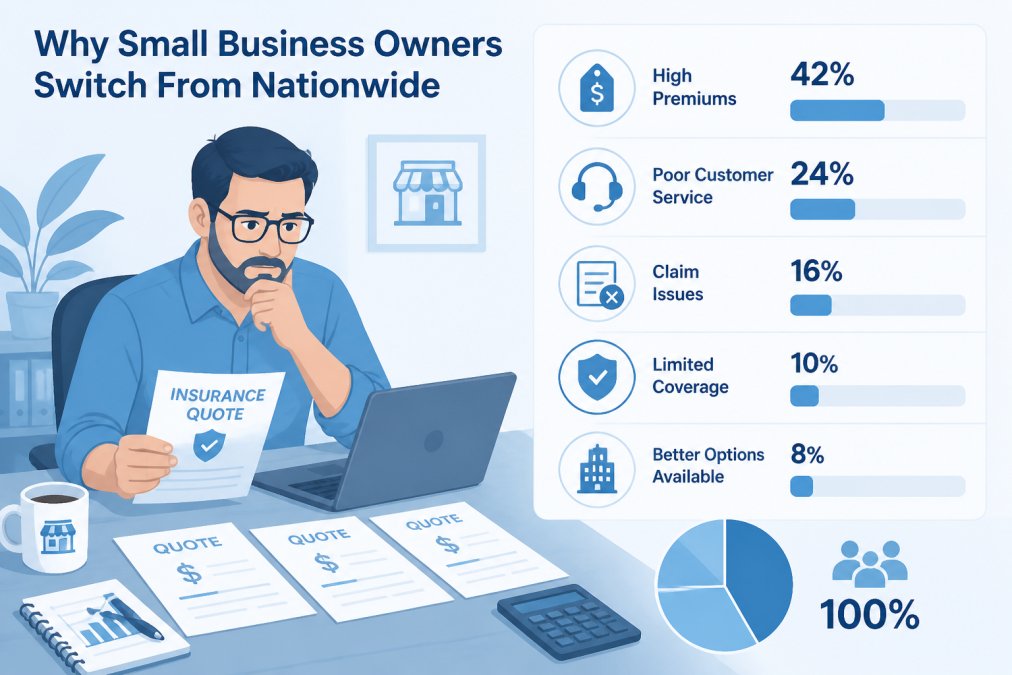
The switching decision builds gradually. A claim gets denied. A renewal quote jumps 30 percent with no justification. An agent becomes unreachable. Over time, these friction points accumulate until business owners realize their insurance doesn't actually protect what matters most.
The real issue isn't just price. It's that large carriers treat all small businesses the same way, offering standardized policies that leave gaps or redundancies. A construction company has different risks than a consulting firm. A one-person operation needs different coverage than a team of ten. Yet most national carriers ignore these differences.
According to the National Federation of Independent Business survey data, small business owners consistently rank personalized service and claims responsiveness as top priorities when evaluating insurance providers. Yet many national carriers prioritize volume over relationships.
The best Nationwide alternatives share a common trait: they're designed specifically for how small businesses actually operate. They understand that coverage needs to flex as your business grows, that claims are moments when you need someone in your corner, and that pricing should reflect your actual risk profile, not a one-size-fits-all formula.
Best Small Business Insurance Companies to Consider
Finding the right insurance partner means understanding what each option actually delivers. The strongest alternatives to national carriers combine accessibility with genuine expertise in small business operations.
Osime Insurance Agency: Personalized Coverage for Local Businesses
Osime Insurance Agency was built specifically for business owners who want to understand their coverage. Rather than pushing standardized policies through an automated system, Osime's specialists take time to understand your actual operations, real risks, and what protection matters for your bottom line.
The agency specializes in home, auto, commercial, and life insurance, which means you can consolidate coverage with one partner who knows your complete situation. This eliminates coverage gaps and avoids redundant protection.
What sets Osime apart is transparency. No hidden exclusions. No surprise denials. The team explains coverage in plain language, not insurance jargon. For business owners frustrated by vague policy language or unclear claim processes, this directness is refreshing.
Osime's approach works especially well for small businesses in specialized industries. If you're in construction, consulting, retail, or any field where standard policies don't quite fit, personalized service means your coverage actually reflects your operation.
Regional Carriers: Specialized Expertise in Your Industry
National carriers have scale. Regional insurers have knowledge. A regional carrier specializing in your industry understands the specific risks you face daily. They've handled hundreds of similar claims and know what coverage gaps matter most.
If you're in construction, a regional carrier focusing on contractors knows your equipment risks, liability exposure, and seasonal fluctuations. That expertise translates to better coverage recommendations and faster, fairer claims handling.
Regional carriers are also more flexible with customization. They'll adjust coverage limits, add endorsements, or structure protection to fit your specific operation. A national carrier might decline requests outside standard offerings. A regional specialist will find a way to make it work.
The trade-off is convenience. Regional carriers may lack 24/7 digital access or nationwide agent networks. But for business owners valuing expertise and personalized attention over convenience, regional specialists often deliver better outcomes.
Digital-First Platforms: Speed and Transparency
Digital-first insurance platforms deliver quotes in minutes, let you manage everything online, and eliminate scheduling appointments. If you have straightforward coverage needs and prefer self-service, digital platforms can be efficient.
These platforms excel at transparency. You see exactly what you're paying for, compare options side-by-side, and understand trade-offs between coverage levels. No agent pressure. No upselling.
The limitation is customization. Digital platforms work best for businesses with standard risk profiles. If your operation is complex or in a specialized industry, digital platforms often can't help. They also shift responsibility to you, if you make a mistake entering information, that's on you. Traditional agents catch these issues.
For straightforward operations like a small retail shop or basic consulting practice, digital platforms work well. For anything more complex, the cost savings often disappear when you realize you didn't get the coverage you actually needed.
How to Choose Business Insurance That Fits Your Needs
The right insurance provider isn't about the biggest name or cheapest quote. It's about alignment between what you need and what the provider delivers.
Start by being honest about your business's real risks. What keeps you up at night? A liability claim that could shut you down? Equipment damage? Injury to employees or customers? Loss of income if you can't work? Your coverage should reflect your actual vulnerabilities.
Next, evaluate how each provider approaches your situation. Call and ask detailed questions. A good provider will ask clarifying questions in return before recommending coverage. If they're rushing to give you a quote, that's a signal they're not thinking deeply about your needs.
Consider claims responsiveness as seriously as price. Ask potential providers about average claims processing time. Ask for references from current customers in your industry. Ask what happens if you disagree with a claim decision.
Finally, think about the relationship. Will you have a consistent point of contact? Can you reach someone during business hours? Do they understand your industry? The best insurance policy is worthless if you can't get clear answers when you need them.
Business Insurance Cost Factors That Affect Your Quote
Insurance pricing is based on measurable factors that correlate with claim likelihood. Understanding these factors helps you see why quotes vary and where you might reduce costs through better risk management.
Industry and operation type drive the biggest pricing differences. A consulting firm and construction company face completely different risk profiles. Contractors deal with equipment, job site hazards, and injury exposure. Consultants face liability for advice and professional errors.
Business size and payroll matter significantly. More employees mean more employment-related claim exposure. Higher payroll typically means higher liability limits and therefore higher premiums.
Claims history is one of the few factors you can control. A clean record demonstrates effective risk management. Multiple claims in a short period signals higher risk. Specialized providers experienced with your industry might accept risk that national carriers won't.
Location affects pricing because some areas have higher claim frequency or litigation costs. Urban areas often cost more than rural areas. You can't change your location, but you can understand that your quote reflects these regional factors.
Safety measures and loss prevention can reduce costs. If you've invested in safety training, equipment, or systems that reduce risk, make sure your provider knows. Some insurers offer discounts for documented loss prevention.
| Cost Factor | Impact | What You Can Control |
|---|---|---|
| Industry type | High | Choose coverage matched to your actual risks |
| Business size | High | Accurate reporting of employees and payroll |
| Claims history | High | Implement loss prevention to avoid future claims |
| Location | Medium | Understand regional pricing, can't change |
| Safety measures | Medium | Document and communicate risk reduction efforts |
| Coverage limits | High | Select limits appropriate to your exposure |
Coverage Types Every Small Business Owner Needs
Not all coverage is equally important for every business. Priorities depend on your operation.
General liability covers bodily injury and property damage claims from customers or the public. Someone slips in your office and breaks their leg. Your work damages a client's property. General liability covers legal fees and settlement costs. This is foundational for nearly every business.
Professional liability applies if you provide services or advice. Consultants, contractors, accountants, and coaches face exposure to claims that your work caused financial loss. General liability doesn't cover this. If you're in a service business, this is essential.
Commercial property covers your building, equipment, inventory, and fixtures. Fire, theft, and vandalism protection covers the physical assets your business depends on.
Workers' compensation is legally required in most states if you have employees. It covers medical costs and lost wages if an employee gets injured on the job. An employee injury without coverage could bankrupt a small business.
Commercial auto covers vehicles used for business. Your personal auto policy doesn't cover business use. If you drive for work, you need commercial auto coverage.
Business interruption covers lost income if your operation is forced to shut down due to a covered event. For businesses with thin margins, this coverage prevents bankruptcy.
Making the Switch: What to Expect From a New Provider
Switching insurance providers creates legitimate concerns. Understanding what actually happens removes much of the anxiety.

Timing matters most. Schedule your new coverage to start on the day your current policy expires. You'll have no gap and avoid overlapping coverage. Your new provider will handle most logistics and coordinate with your old insurer.
Your claims history transfers with you. When you move to a new provider, your claims record comes along. Your new provider will review your history and price accordingly.
Coverage won't change unless you change it. If you move from one general liability policy to another, your coverage remains essentially the same unless you request modifications. A specialist will review your old coverage, identify gaps, and recommend improvements.
The transition usually takes 1-2 weeks. Your new provider gathers information, issues a quote, you approve it, and they issue the policy. Once issued, you're covered immediately.
Claims filed after you switch go to your new provider. If something happens after your policy switches, your new provider handles it. This is why choosing a provider with strong claims responsiveness matters.
The actual switching process is less dramatic than most business owners expect. Providers do this constantly and have established systems. Your job is to provide accurate information and choose a provider you trust.
Switching from a national carrier to a provider better suited to your actual needs doesn't require sacrificing protection. It requires being honest about what you need and finding a provider who listens.
At Osime Insurance Agency, we've helped numerous business owners move from larger carriers to coverage that actually reflects their operation. Our specialists understand small business risk because we work with small business owners every day. We handle home, auto, commercial, and life insurance with the same commitment to transparency and personalized service. Get your free quote and see how coverage designed specifically for your business compares to what you're paying now.
Frequently Asked Questions
What are the main reasons small business owners look for Nationwide alternatives?
Small business owners often seek alternatives due to limited customization for their industry, higher premiums than specialized carriers, complex claims processes, or a desire for more personalized service. Many find that national carriers treat small businesses as one-size-fits-all, missing coverage gaps specific to their operations. Switching to providers offering tailored policies, faster claims handling, and dedicated agent support addresses these pain points and provides better alignment with actual business needs.
How do I know which business insurance company is right for my specific industry?
Start by identifying your industry's unique risks, construction faces different exposures than consulting or retail. Look for carriers with documented experience in your field and ask about their claims history in similar businesses. Request quotes from multiple providers and compare not just price but coverage specificity. Agencies like Osime Insurance Agency specialize in understanding industry-specific needs and can explain exactly which coverage types protect your operations best, ensuring you're not paying for irrelevant coverage.
What business insurance cost factors should I discuss with a new provider?
Key cost factors include your annual revenue, number of employees, business location, claims history, and industry classification. Your business's safety record, years in operation, and revenue projections also affect premiums. Digital platforms often quote faster by automating these inputs, while specialist agents may negotiate better rates by understanding your specific risk profile. Request a detailed breakdown of what drives your quote so you can identify areas where risk management improvements might lower costs.
Is switching insurance providers a complicated process?
Switching is straightforward when you plan ahead. Request quotes 30-60 days before your current policy renews to avoid coverage gaps. Gather your existing policy details and loss history, then provide them to new providers. Most carriers handle cancellation of your old policy once the new one starts. Work with an experienced agent who can ensure continuous coverage and answer questions about differences between policies, making the transition smooth and stress-free.
This article was written using GrandRanker