 listicle
Benefits of Working With Independent Agents
Table of Contents
- What Independent Agents Offer That Captive Agents Don't
- Access to Multiple Insurance Carriers and Better Coverage Options
- Personalized Service and Tailored Coverage Solutions
- Claims Advocacy: Your Agent in Your Corner
- How to Choose an Insurance Agent That Fits Your Needs
- Technology vs. Human Touch: Why Independent Agents Still Matter
- Fee Transparency and Understanding Agent Compensation
- Conclusion
Last Updated: August 9, 2026
What Independent Agents Offer That Captive Agents Don't
A captive agent represents a single insurance company and sells only that company's policies. An independent agent represents multiple carriers and can shop your coverage across several options to find the best fit for your situation. This structural difference shapes everything about how you'll experience your insurance relationship.
When you work with a captive agent, their incentive is to sell their company's product. When you work with an independent agent, their incentive is to keep you as a long-term client, which means finding coverage that actually works for your life. Independent agents have flexibility that captive agents don't: they can layer coverage from different carriers, customize terms, and adjust deductibles in ways that captive agents are constrained from doing. For complex situations, high-risk businesses, unique coverage gaps, or layered liability needs, that flexibility becomes invaluable.
At Osime Insurance Agency, Inc, we operate as independent agents, which means your coverage isn't limited to one company's product line. We can access multiple carriers and customize solutions that match your actual risk profile rather than fitting you into a predetermined box.
Access to Multiple Insurance Carriers and Better Coverage Options
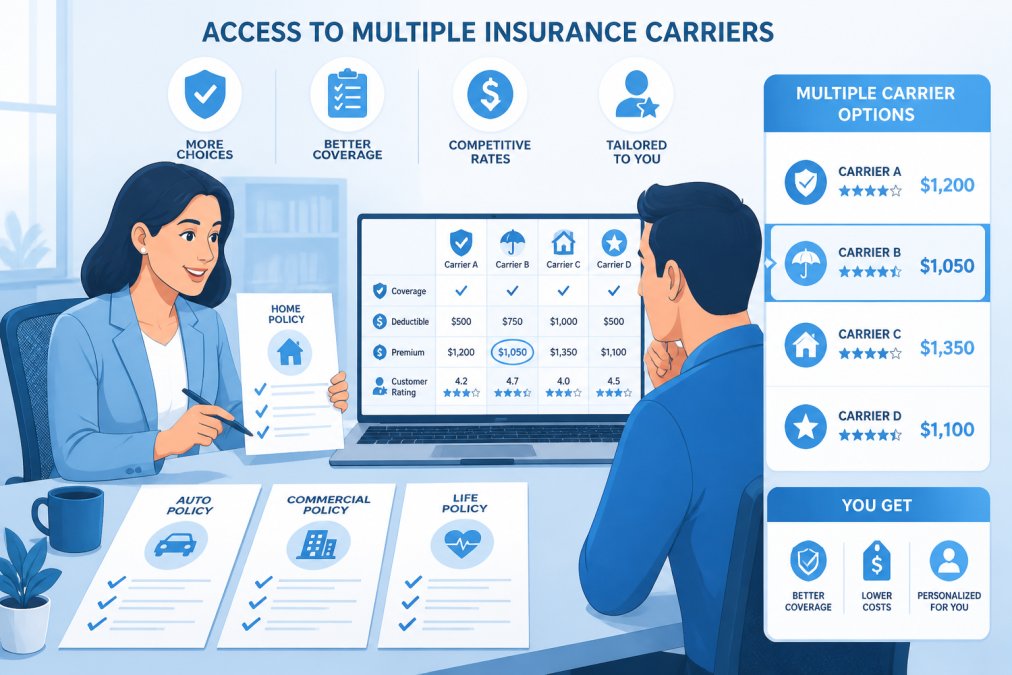
The single biggest advantage of working with independent agents is access. When you have multiple carriers available, you're not negotiating from a position of weakness. You have genuine options.
An independent agent can compare quotes from multiple carriers simultaneously, giving you meaningful choice instead of a take-it-or-leave-it offer from one company. For homeowners, this means finding a carrier that specializes in your property type. For business owners, it means accessing carriers that understand your industry instead of applying generic rates. Consider a construction contractor seeking commercial liability coverage: a captive agent might have one or two options within their company's appetite, while an independent agent can access specialized carriers that underwrite construction regularly and understand the actual risk profile, resulting in better terms and often lower premiums.
Multiple carrier access also protects you from being trapped. If one carrier decides to exit your market or raise rates dramatically, an independent agent can move your coverage to another carrier without starting from scratch.
Personalized Service and Tailored Coverage Solutions
Generic policies apply to millions of people with minimal customization, but your situation probably isn't generic. You have specific assets, specific risks, and specific needs that a one-size-fits-all policy won't fully address.
Independent agents build their business on customization. They spend time understanding your situation because deeper understanding leads to better coverage recommendations and fewer claims disputes. Tailored coverage means identifying coverage gaps that standard policies miss, for example, standard homeowners insurance doesn't cover water damage from a backed-up sewer. It also means adjusting coverage limits to match your actual assets and liability exposure, and recommending deductible levels that balance your premium costs with your out-of-pocket risk tolerance.

Claims Advocacy: Your Agent in Your Corner
The real test of your insurance relationship is when you file a claim. That's when you discover whether your agent is actually on your side or just a salesperson who disappears after the sale.
Independent agents have a financial incentive to advocate for their clients during claims. If an insurer denies a legitimate claim or drags out the process, the client feels the pain directly and may switch agents. An independent agent's reputation and retention depend on how well they handle claims, which means they're motivated to push back when necessary and ensure their clients are treated fairly.
When you file a claim, your independent agent can help you document the loss properly, communicate with the adjuster, and ensure nothing gets overlooked. For complex claims, commercial property damage, liability disputes, or multi-policy coordination, this support becomes essential. The adjuster works for the insurance company. Your independent agent works for you.
How to Choose an Insurance Agent That Fits Your Needs
Not all independent agents are created equal. Finding the right agent means understanding what you need and matching it to an agent who has relevant expertise.
Start by identifying your primary coverage need. Are you a first-time homebuyer? A small business owner? An agent with deep experience in your specific situation will ask better questions and recommend more appropriate coverage than a generalist.
Next, evaluate the agent's communication style and responsiveness. Does the agent explain things clearly? Do they return calls promptly? Do they seem genuinely interested in your situation?
Ask about their carrier relationships and specializations. Which carriers do they work with? Some independent agents have deep relationships with specific carriers that translate into better rates and more flexible underwriting. Check their credentials and experience, look for relevant certifications like Certified Insurance Counselor or Chartered Property Casualty Underwriter designations. Finally, assess their technology and service model. Can you manage your policies online? Can you request changes or file claims digitally?
| Factor | What to Look For | Red Flags |
|---|---|---|
| Experience | Agent specializes in your coverage type | Agent is new to industry or unfamiliar with your needs |
| Responsiveness | Calls/emails returned within 24 hours | Delayed responses or difficulty reaching agent |
| Carrier Access | Works with multiple carriers relevant to your situation | Limited carrier relationships or pushes one carrier |
| Communication | Explains policies clearly without jargon | Uses insurance jargon without explaining or seems evasive |
| Credentials | Holds relevant industry certifications | No certifications or professional development |
| Service Model | Offers digital access and multiple contact methods | Only available during business hours or limited channels |
Technology vs. Human Touch: Why Independent Agents Still Matter
Insurance technology has advanced dramatically. You can get quotes online in minutes, compare policies side-by-side with a few clicks, and even file claims through an app. Yet technology handles routine parts of insurance well but not the complex parts. Technology can show you five different policy options, but it can't tell you which is right for your situation. It can process straightforward claims quickly but can't advocate for you when a claim gets denied.
Independent agents have embraced technology as a tool to compare quotes faster, manage policies more efficiently, and provide better service. Consider a business owner with a complex operation: online quote systems might not recognize their business type or might apply generic rates that don't reflect actual risk. An independent agent with industry knowledge can identify the right underwriters and negotiate terms that an automated system couldn't access.
The future of insurance isn't technology replacing agents, it's technology enabling agents to provide better service. Agents who thrive use technology to handle routine tasks efficiently, freeing up time for what technology can't do: understanding complex situations, providing expert advice, and advocating for clients when it matters most.
Fee Transparency and Understanding Agent Compensation
Most independent agents earn commission-based compensation, they receive a percentage of your premium from the insurance carrier, typically ranging from 10% to 15% for personal lines and higher for commercial policies. This structure has been standard in the insurance industry for decades.
The key question is whether this creates a conflict of interest. Theoretically, it could incentivize recommending more expensive policies to earn higher commissions. In practice, several factors work against this. First, most agents' revenue comes from renewal commissions, clients who stay year after year. Recommending inappropriate coverage to earn a slightly higher commission makes no sense if the client gets a bad experience and switches agents. Second, insurance carriers have underwriting guidelines that prevent agents from recommending coverage that doesn't match the client's actual risk profile.
Some independent agents operate on a fee-for-service model instead of commissions, charging a flat fee or hourly rate for their advice without earning commission on policies. This eliminates commission-based incentives entirely, though clients pay directly for the advice rather than having it subsidized by carrier commissions.
Ask your independent agent how they're compensated. Commission-based compensation doesn't make an agent untrustworthy, but transparency about how they're paid does matter. You should know how your agent makes money and feel confident that their recommendations are based on your needs, not their commission potential.
Osime Insurance Agency, Inc prioritizes transparency about how we're compensated and what that means for your coverage recommendations.
Conclusion
The decision to work with an independent agent comes down to a simple principle: you want someone whose success depends on your long-term satisfaction, not just closing a sale. Independent agents operate under that principle because their business model depends on client retention and referrals. They have access to multiple carriers, the flexibility to customize coverage, and the incentive to advocate for you when it matters most.
At Osime Insurance Agency, Inc, we specialize in home, auto, commercial, and life insurance with a commitment to personalized service and transparent communication. We take time to understand your specific situation, compare options across multiple carriers, and ensure your coverage actually protects what matters.
Get your free quote from Osime Insurance Agency, Inc and discover how personalized, transparent insurance service can make a real difference.
Frequently Asked Questions
What is the difference between independent agents and captive agents?
Independent agents work with multiple insurance carriers, giving you access to a wider range of coverage options and competitive quotes. Captive agents represent only one insurance company, limiting your choices to that company's products. Independent agents can compare policies across carriers to find the best fit for your needs, while captive agents can only offer their employer's coverage, regardless of whether it's the most affordable or comprehensive option for your situation.
Do independent insurance agents charge extra fees for their services?
Most independent agents earn commissions directly from insurance carriers when you purchase a policy, so you don't pay an additional fee out of pocket. However, some independent agents may charge consultation fees for complex coverage needs or specialized services. It's important to ask about compensation upfront so you understand exactly how your agent is paid. This transparency helps you trust that recommendations are based on your needs, not just commission potential.
How do independent agents help during the claims process?
Independent agents serve as your advocate when you file a claim. They review your policy to ensure the claim is filed correctly, follow up with the insurance carrier on your behalf, and help resolve any disputes or delays. If the carrier denies or underpays your claim, your agent can push back and fight for fair coverage. This personal advocacy is one of the biggest advantages of working with an independent agent, you're not navigating the claims process alone.
Are independent agents worth it if I'm on a tight budget?
Yes. Independent agents can often find you more affordable coverage than you'd get on your own because they have access to multiple carriers and can compare quotes instantly. They know which insurers offer the best rates for your specific situation, whether you're a first-time homebuyer, self-employed, or in a high-risk industry. By shopping across carriers rather than limiting you to one company's options, independent agents frequently uncover discounts and bundled policies that save you money without sacrificing protection.
This article was written using GrandRanker