 How-to
10 Process Safety Management Best Practices That Work
Last Updated: October 29, 2026
Quick Summary
Process safety management works best when it is built around people and written down clearly, with every element owned by a named person. The OSHA standard 29 CFR 1910.119 lists 14 elements that must work together as one connected system. Strong programs focus on process hazard analysis with operators on the team and track every recommendation to closure.
- OSHA's standard lists 14 elements that a PSM program must cover.
- A process hazard analysis must be revalidated at least every five years.
- Include at least one operator with process-specific experience on the PHA team.
- Track every PHA recommendation with an owner, due date, and resolution record.
- Use near-miss report counts as a leading indicator, since rising reports usually signal trust.
Table of Contents
- The 14 Process Safety Management Elements Under OSHA 29 CFR 1910.119
- Process Hazard Analysis Best Practices That Hold Up to Review
- Assigning Owners and Timelines for Process Safety Management Implementation
- Measuring Performance with Leading and Lagging Indicators
- Process Safety Management Audit Checklist for Small and Mid-Sized Facilities
- Your Next Step: Schedule a PSM Gap Review
- Frequently Asked Questions
Process safety management is a set of rules that keeps workers safe around highly hazardous chemicals and equipment. The best process safety management programs share a simple habit: they are built around people and written down clearly.
Process safety management, or PSM, is the system that controls the risk of a catastrophic incident, such as a fire, explosion, or large release of a dangerous chemical. The United States sets the main requirements for it through the Occupational Safety and Health Administration (OSHA) in OSHA Process Safety Management standard, 29 CFR 1910.119.
Many operators find that PSM is more than a compliance task. It is how a site keeps track of what can go wrong and who is responsible for stopping it. When the program works, small problems get caught early, before they become headline events.
- Protects workers, neighbors, and equipment from serious releases
- Gives leaders a clear picture of process risk
- Creates a record that shows regulators and insurers the site takes safety seriously
The 14 Process Safety Management Elements Under OSHA 29 CFR 1910.119
The OSHA standard lists 14 elements that a PSM program must cover. They include process safety information, process hazard analysis, operating procedures, employee training, contractor safety, and mechanical integrity.
A common mistake is treating the 14 elements as separate projects owned by different departments. The elements depend on each other.
Start by mapping each element to a named owner and a place where its records live. This turns the standard into a working map instead of a binder on a shelf.
| Element | Core Question | Typical Evidence |
|---|---|---|
| Process safety information | Do we know what is in the process? | Current diagrams, chemical data sheets |
| Process hazard analysis | What could go wrong, and how bad could it be? | Analysis reports, action items |
| Operating procedures | How do we run it safely? | Signed, current procedure documents |
| Employee training | Does each worker know the procedures? | Training records and sign-offs |
| Mechanical integrity | Is the equipment still sound? | Inspection and test logs |
Process Hazard Analysis Best Practices That Hold Up to Review
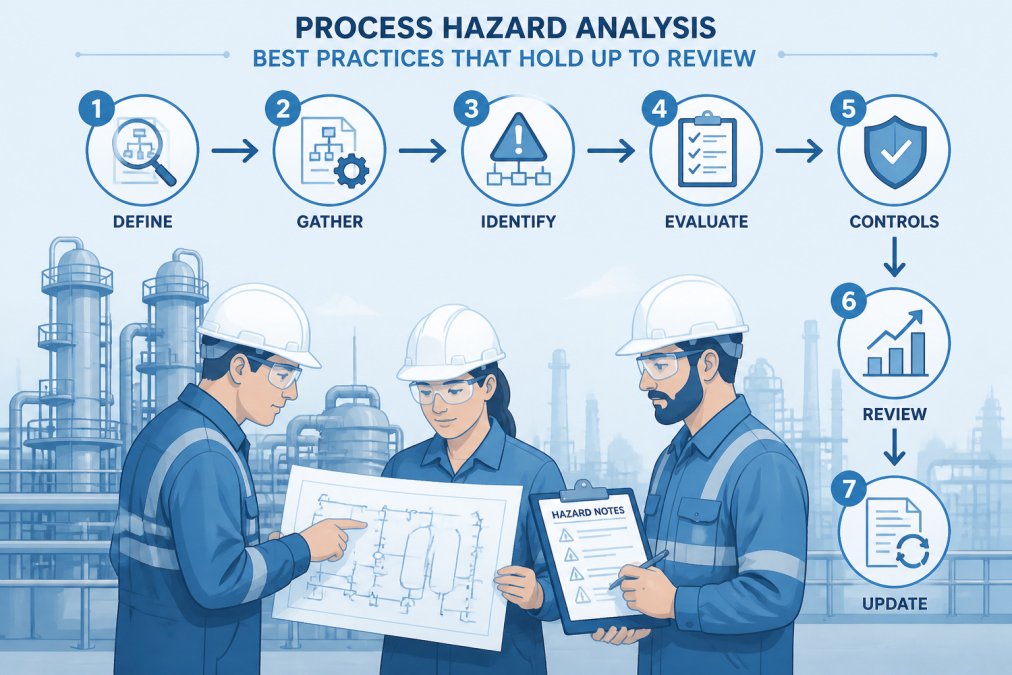
Process hazard analysis, or PHA, is where most teams find their biggest gaps. Under OSHA 29 CFR 1910.119(e), a PHA must identify, evaluate, and control hazards in a covered process, and it must be revalidated at least every five years. A strong PHA asks what could happen, how often it might happen, and what safeguards already exist.
Choose the Right PHA Method
No single method fits every process. The table below shows the common methods and when each tends to work best.
| Method | Best For | Typical Team Size |
|---|---|---|
| What-If | Simple processes with few hazards | 3-5 people |
| Checklist | Processes with well-known hazards and mature procedures | 3-5 people |
| HAZOP | Complex processes with many nodes and deviations | 5-8 people |
| Failure Mode and Effects Analysis (FMEA) | Equipment-focused reviews | 3-6 people |
| Layer of Protection Analysis (LOPA) | Quantifying whether safeguards are sufficient | 4-6 people |
A common pattern is to use HAZOP for the core process and What-If or checklist reviews for utility systems and minor changes. LOPA is often applied after a HAZOP when a team needs to decide whether an independent protection layer is adequate.
Build a Team That Includes Operators
The analysis should be done by a team that includes operators who work the process every day, not just engineers working from a desk.
Here is where it gets interesting: the most useful PHA sessions are often the least comfortable. Teams that openly discuss near misses and past incidents tend to produce better recommendations than teams that stay polite. A facilitator who invites the quietest operator to speak first often surfaces the most valuable findings.
Document Recommendations and Track Them to Closure
Write down every recommendation and track it to closure. A PHA that generates action items nobody completes is one of the most common findings in an audit. Each recommendation should carry a named owner, a due date, a resolution status, and a record of what was actually changed.
When a recommendation is rejected, document why. Regulators and auditors accept a reasoned, documented decision; they rarely accept a blank field.
Know When to Revalidate
A PHA done once and filed away goes stale quickly. Revalidate at least every five years, and sooner whenever there is a significant change: a new chemical, a changed process technology, a major equipment replacement, or a modification that triggers management of change. Treat revalidation as a fresh look, not a paperwork update.
Keep the Records Audit-Ready
Store the PHA report, the team roster with qualifications, the method used, the recommendations, and the resolution status in one place. When an inspector asks for the PHA, the follow-up question is almost always about what happened to the recommendations. A complete record answers both in one pass.
Assigning Owners and Timelines for Process Safety Management Implementation
A PSM program succeeds or fails on accountability. Every element needs one person who answers for it, plus a realistic timeline for building or updating it. Without an owner, tasks drift until an inspection reveals them.
Many small and mid-sized sites start with a simple sequence. The steps below show one practical order, though the right pace depends on the size of the operation.
- Name a PSM lead with authority to stop work and request resources
- Assign one owner per element and set a review date for each
- Build the process safety information package first, since other elements depend on it
- Complete the PHA and log every recommendation with a due date
- Update procedures, then train workers on the updated versions
- Schedule the first compliance audit before the program is fully mature
Measuring Performance with Leading and Lagging Indicators
Most sites measure PSM only by counting incidents. That is a lagging indicator, and it tells you about failures after they happen. Leading indicators show whether the system is working before something goes wrong.
Examples of useful leading indicators include the percentage of PHA recommendations closed on time, the number of overdue inspections, and the rate of near-miss reports filed by workers.
Review these numbers in the same meeting each month. Keep the list short, so the team focuses on the few measures that really show progress.
Process Safety Management Audit Checklist for Small and Mid-Sized Facilities
Limited staff does not mean limited responsibility. Smaller facilities can run an effective PSM program by focusing on the elements that create the most risk and by using simple, repeatable records. Smaller teams often struggle to scale the program when they do not have a full-time PSM department. The approach below is built for teams of one to five people who wear multiple hats.
Prioritize by Consequence, Not by Element Number
Start with the elements that prevent the worst outcomes. For most small facilities, that means process safety information, process hazard analysis, operating procedures, training, and mechanical integrity. Contractor safety, hot work permits, and management of change come next. Pre-startup safety reviews and incident investigation can be built as simple forms until the program matures.
A practical rule: if a gap in an element could lead directly to a loss of containment, fix it first. If a gap would mainly create a documentation finding, schedule it for the next quarter.
A Phased Roadmap with Owners and Milestones
Use a 90-day first phase, a 90-day second phase, and an annual review cycle. Assign one owner per phase, even if that person also owns several elements.
| Phase | Focus | Owner | Milestone |
|---|---|---|---|
| Days 1-90 | Process safety information and PHA | Site lead | Current diagrams and a completed PHA with tracked recommendations |
| Days 91-180 | Procedures, training, mechanical integrity | Operations supervisor | Signed procedures, training records, inspection schedule |
| Days 181-365 | Contractors, hot work, management of change, audit | Safety coordinator | Permit process in use, MOC log active, first internal audit complete |
This sequence works because each phase produces records the next phase depends on. Training cannot be verified against procedures that do not exist, and an audit cannot judge a program that has not been built.
Use a Simple Evidence File
For each element, keep one folder or shared drive location with the current record and the date it was last reviewed. The checklist below is designed to be answered with a yes, no, or date, so it can be completed in under an hour.
- Process safety information is current and easy to find (last review date: ____)
- Every PHA recommendation has an owner and a due date (open items: ____)
- Operating procedures are signed and reviewed in the past year (last review: ____)
- Training records match the workers who run each process (last drill: ____)
- Critical equipment has an inspection schedule that is being followed (overdue items: ____)
- Contractors receive a safety briefing before starting work (briefing log: ____)
- Management of change steps are used for every process modification (MOC log: ____)
Scale the Program Without Cutting Corners
Small teams often try to copy a large-company program and then abandon it. A better approach is to keep the required elements but simplify the format. A one-page procedure can satisfy the standard if it is accurate and current. A PHA can be a facilitated What-If session rather than a multi-week HAZOP. The key is that the record exists, is current, and is used by the people doing the work.
Prepare for the Insurance and Audit Conversation
Insurance and risk questions often come up during audits. A documented PSM program can make insurance and audit conversations clearer.
Your Next Step: Schedule a PSM Gap Review
A gap review is the fastest way to see where your program stands. Compare your current records against the 14 elements, name an owner for each gap, and set realistic dates to close them. Talking with an insurance professional can help you understand the risk side of that plan. Get Your Free Quote to start the conversation.
Frequently Asked Questions
What are the key elements of process safety management?
OSHA's process safety management standard, 29 CFR 1910.119, lists 14 elements that apply to processes involving highly hazardous chemicals above specified thresholds. They include employee participation, process safety information, process hazard analysis, operating procedures, training, contractor management, pre-startup safety review, mechanical integrity, hot work permits, management of change, incident investigation, emergency planning, compliance audits and trade secrets. Together they form a management system rather than a single document, so each element should have a named owner and records that show the work is done.
How often should a process hazard analysis be reviewed?
OSHA requires that each process hazard analysis be updated and revalidated at least every five years after its initial completion. Many facilities review sooner when a process changes, when an incident occurs or when a near miss reveals a gap. Using the management of change procedure to trigger a PHA review for any significant change keeps the analysis current between the formal five-year cycles.
What should a process safety management audit include?
OSHA requires compliance audits at least every three years to certify that the PSM elements are being followed. A useful audit checklist confirms that process safety information is current, procedures match actual operations, training records are complete, mechanical integrity inspections are on schedule and corrective actions from prior audits are closed. Document findings, assign corrective actions with owners and due dates, and verify closure.
Which OSHA standard covers process safety management?
The process safety management standard is 29 CFR 1910.119 for general industry, and a parallel standard applies to construction work. It covers processes that involve highly hazardous chemicals at or above the quantities listed in the standard's appendix A. Facilities should confirm whether their chemical inventory triggers coverage before building the program.