 How-to
7 Tips for Comparing Car Insurance Quotes
Last Updated: October 29, 2026
Quick Summary
To compare car insurance quotes fairly, gather your driver and vehicle details, hold coverage limits and deductibles constant across every quote, and use a checklist so nothing gets missed. Then look past price to insurer quality, complaint ratios and claims handling before you choose.
- Gather VIN, license numbers, garaging address and odometer-based annual mileage before requesting any quote.
- Verify VIN accuracy, mileage and household drivers on each quote, since input errors can shift premiums by hundreds of dollars a year.
- Ask insurers to re-quote on identical limits, deductibles, driver lists and mileage so the remaining gap reflects rate, not coverage.
- Pick the highest deductible you could pay without stress, then compare premiums at that level across insurers.
- Shortlist insurers within a modest percentage of the lowest comparable quote, then choose on claims handling and complaint ratio.
Table of Contents
- Gather Your Driver and Vehicle Details First
- Use a Car Insurance Quote Comparison Checklist
- Match Coverage Limits and Deductibles Across Quotes
- Car Insurance Deductible Comparison: How Your Choice Changes the Premium
- Car Insurance Quote Comparison Examples: Reading Two Quotes Side by Side
- Compare Car Insurance Quotes Online Without Getting Buried in Leads
- Look Past Price to Insurer Quality and Claims Handling
- Get Your Free Quote From Osime and Compare With Confidence
- Frequently Asked Questions
Gather Your Driver and Vehicle Details First
Accurate car insurance quotes start with accurate information. Before you request a single quote, pull together the details every insurer will ask for. Getting this right the first time saves you from quotes that look cheap but don't reflect your real situation.
Here's what to gather:
- Full legal names, dates of birth, and license numbers for every household driver
- Vehicle identification number (VIN), make, model, and year for each car
- Your garaging address, which affects rates more than most people expect
A common mistake is guessing at annual mileage or leaving off a household driver. If your credit profile is part of the picture, it's worth understanding how credit affects the quotes you receive before you start.
Use a Car Insurance Quote Comparison Checklist
A car insurance quote comparison checklist is a simple list of the fields you compare across every quote so nothing gets missed.
Run through this for each quote:
- Coverage type and limits (liability, collision, comprehensive, uninsured/underinsured motorist)
- Deductible amount for each coverage
- Monthly and annual premium, plus any installment fees
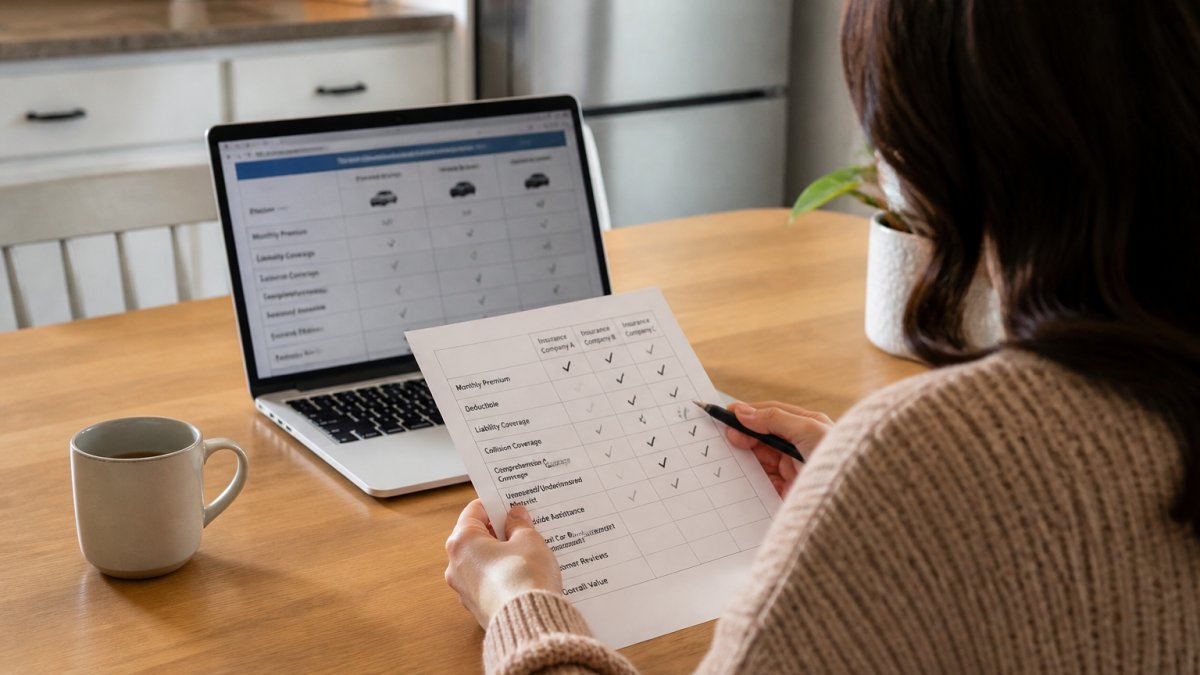
Write the answers down. Memory is a poor comparison tool, and the quote that felt cheapest last week often isn't once you line up the details.
Check the Inputs Before You Check the Price
Most quote errors start with the information you entered, not the insurer's math. A wrong VIN, a guessed mileage figure, or a missing household driver can shift a premium by hundreds of dollars a year, and the error often surfaces only at renewal or claim time. Before you compare prices, verify these inputs on every quote:
- VIN accuracy. A single transposed character can pull the wrong trim, engine, or safety features and change the rate. Read the VIN from the door jamb or insurance card, not from memory.
- Annual mileage. Insurers price low-mileage and high-mileage drivers differently. Use your odometer readings from the past 12 months rather than a round-number guess.
- Household drivers. Most policies require you to list all licensed household members, even if they rarely drive your car. Omitting one can void a discount or create a coverage dispute.
Normalize Quotes Built on Different Assumptions
Even with a checklist, quotes often arrive on different terms: one includes a paid-in-full discount, another assumes a higher deductible, a third bundles renters coverage you didn't ask for. A quote built on different assumptions isn't a comparison, it's a guess. Use this three-step method to level them:
- Identify the assumptions. Ask the agent or quote page which discounts, deductibles, limits, and fees are baked in. Note anything marked "estimated" or "subject to verification."
- Re-quote on identical terms. Request the same limits, the same deductible, the same driver list, and the same mileage from every insurer. Most agents will re-run a quote in minutes.
- Compare the residual difference. Once the inputs match, the remaining premium gap reflects the insurer's rate, not a coverage gap, which is the only fair basis for a price decision.
Keep a One-Page Comparison Sheet
A simple spreadsheet or paper sheet with one column per quote and one row per checklist item makes the differences obvious. Include a final row for "annualized total cost after discounts and fees" so a low monthly payment with a large down payment doesn't win by default. When you're done, the sheet should show which quote is cheapest at identical coverage, and which insurer you'd actually trust to pay a claim.
Match Coverage Limits and Deductibles Across Quotes
The cheapest quote is usually cheap for a reason: lower limits or a higher deductible. To compare fairly, hold coverage limits and deductibles constant across every quote you collect.
Ask each insurer for the same liability limits and the same deductible. If you're unsure how liability and comprehensive coverage differ, this guide to liability vs. comprehensive coverage explains the distinction before you match them across quotes.
Watch out: a quote with lower limits can look like a bargain until you need to file a claim and find the payout capped well below your costs.
Car Insurance Deductible Comparison: How Your Choice Changes the Premium
A car insurance deductible comparison comes down to one trade-off: a higher deductible lowers your premium but raises your out-of-pocket cost when you file a claim. The right number depends on how much you could comfortably pay tomorrow if something happened.
Use this simple framework:
| Deductible Level | Effect on Premium | Best For |
|---|---|---|
| Low deductible | Higher premium | Tight budgets, low savings cushion |
| Mid deductible | Balanced | Most households |
| High deductible | Lower premium | Drivers with emergency savings |
Pick the highest deductible you could pay without stress, then compare premiums at that level across insurers. Comparing premiums at different deductibles tells you nothing useful.
Car Insurance Quote Comparison Examples: Reading Two Quotes Side by Side
Real car insurance quote comparison examples make the method click. Picture two quotes for the same driver and vehicle:
- Quote A: lower premium, higher deductible, state-minimum liability limits
- Quote B: higher premium, mid deductible, higher liability limits
On price alone, Quote A wins. But if you raise Quote A's limits to match Quote B, the gap shrinks, and sometimes reverses. That's the whole game: normalize the coverage, then compare.
When quotes use different assumptions, such as one including a discount that expires, ask the insurer to re-quote on identical terms. A quote built on different assumptions isn't a comparison, it's a guess.
Compare Car Insurance Quotes Online Without Getting Buried in Leads
You can compare car insurance quotes online in minutes, but the trade-off is your contact information. Many comparison sites sell leads to multiple agencies, and your phone starts ringing before you've finished reading.
Protect yourself with a few habits:
- Use a secondary email address for quote requests
- Read the site's privacy policy before entering your details
- Prefer sites that show quotes without requiring a phone number
- Expect follow-up calls and know how to opt out
None of this means skip online tools. It means go in with your eyes open. The information you hand over is the price of the quote.
Look Past Price to Insurer Quality and Claims Handling
The best quote is worthless if the insurer drags its feet when you file a claim. Price matters, but so does what happens on your worst day. Most comparison guides stop at "check reviews." This section gives you a repeatable way to evaluate an insurer before you commit, using public records and a short set of claims questions.
Use Public Records, Not Just Star Ratings
Customer star averages are easy to game and often reflect billing disputes rather than claims outcomes. Three better sources:
- Complaint ratios published by state insurance regulators. Many state departments of insurance publish annual complaint data that compares a company's complaint volume to its premium volume. A company with a high complaint ratio relative to its size is a warning sign, even if its average star rating looks fine.
- Financial strength ratings from independent agencies. Ratings from established rating agencies (such as A.M. Best, S&P, or Moody's) indicate whether an insurer has the capital to pay claims in a downturn. A rating in the secure range is the baseline; a downgrade trend is worth noting.
- Market-conduct and enforcement actions. State regulators publish enforcement actions and market-conduct reports. A pattern of fines for claims-handling or billing practices is more informative than a handful of angry reviews.
Ask These Claims Questions Before You Sign
A quote tells you what you'll pay. A short conversation with the claims department tells you what you'll experience. Ask:
- Who handles claims, staff adjusters or a third-party administrator? Third-party administration isn't automatically bad, but it changes who you call and how quickly issues escalate.
- What is the typical time to first contact after a claim is filed? Ask for the standard, not a best case.
- Can I choose my own repair shop? Some insurers steer policyholders to network shops; others let you use any licensed shop. Know which applies to your policy.
- How are total losses valued, and what documentation do you require? The valuation method (actual cash value vs. replacement cost) and the paperwork burden affect your payout.
If you want to know what strong claims support looks like, this breakdown of what to look for in car insurance claims support covers the questions to ask before you sign. A slightly higher premium from an insurer that answers the phone and pays claims is often the better deal.
Weigh Service Against Price, With a Simple Rule
Set a price band rather than chasing the absolute lowest number. A common approach is to shortlist insurers within a modest percentage of the lowest comparable quote, then choose among them on claims handling, complaint ratio, and financial strength. That way you're not overpaying for service you won't use, and you're not buying the cheapest policy from an insurer you'd dread calling.
Get Your Free Quote From Osime and Compare With Confidence
Comparing car insurance quotes rewards preparation. Gather your details, use a checklist, hold coverage constant, and look past the sticker price to the insurer behind it.
At Osime Insurance Agency, Inc, we make that comparison simpler.
Ready to see how your options stack up? Get a free quote from Osime Insurance Agency, Inc. Compare with confidence and choose coverage that actually protects you.
Frequently Asked Questions
Is it better to have a $500 deductible or a $1000 deductible?
It depends on how much you can pay out of pocket after a claim. A $500 deductible means a higher monthly premium but a smaller bill when you file. A $1000 deductible lowers the premium but leaves you covering more of the repair yourself. Run a car insurance deductible comparison on the same coverage: if the premium difference is small, the lower deductible often makes sense. If you have savings set aside, the higher deductible can reduce your rate.
What information do you need to compare auto insurance quotes accurately?
You need driver information for every household member, vehicle information including make, model, and VIN, your driving history, annual mileage, vehicle use, garaging address, and claims history for the past few years. Missing any of these makes quotes hard to compare because each insurer may assume something different. A car insurance quote comparison checklist keeps the details consistent so the prices you see reflect the same driver and the same vehicle.
Should you compare coverage limits and deductibles when shopping for car insurance quotes?
Yes. A cheap quote often reflects lower liability coverage, no collision or comprehensive coverage, or a high deductible. Line up coverage limits, deductibles, and optional coverage like uninsured motorist coverage and personal injury protection before you judge price. Two quotes only compare fairly when the policy options match. Ask each insurance provider to confirm the same limits in writing.
What should you avoid telling an insurance company when getting a quote?
Never guess at annual mileage, garaging address, or household drivers to lower a rate. Inaccurate information can lead to a claim denial or a mid-term premium adjustment. Give accurate information and let the agent find legitimate discounts, such as bundling auto and home policies. If you are unsure about a detail, say so and ask how the insurer treats it rather than estimating.